
Why Back to Wall Bathtubs Are Specified in Modern Residential Projects
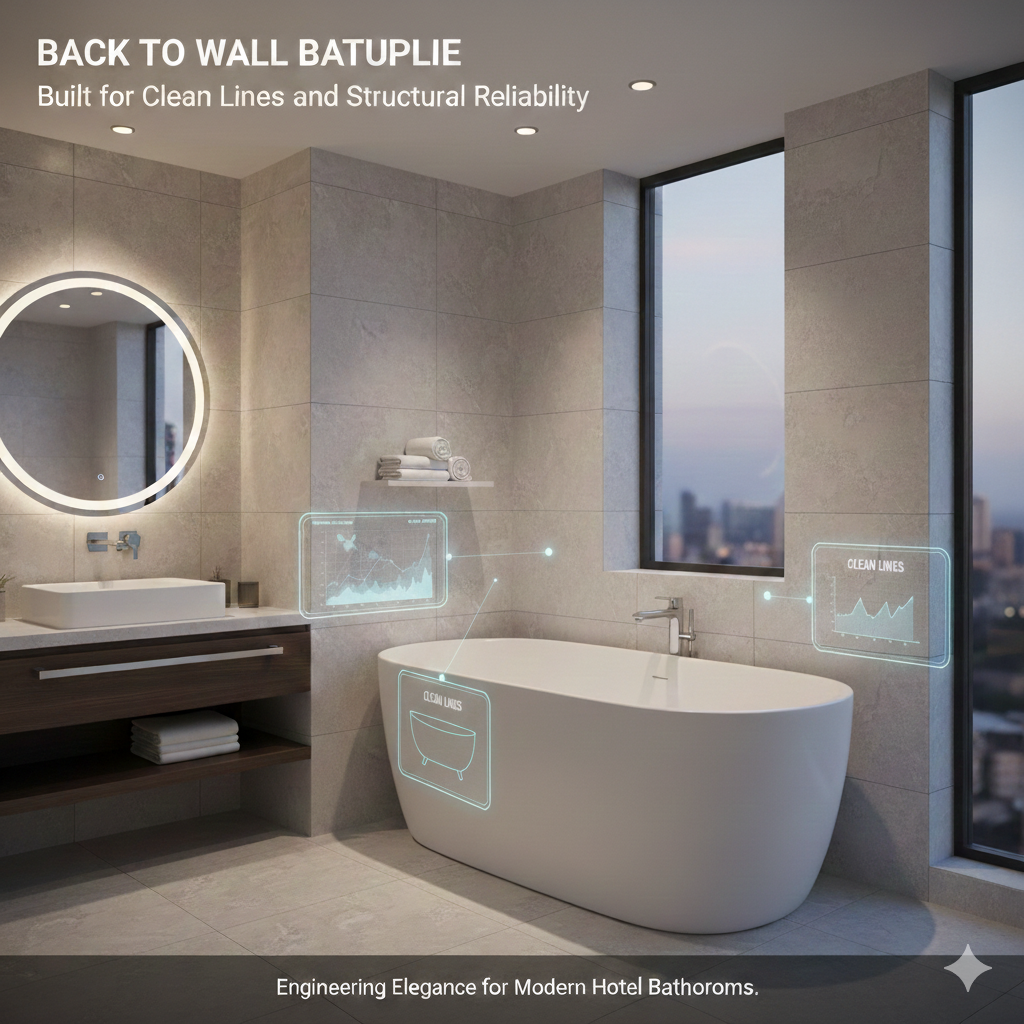
Back to wall bathtubs are not selected purely for visual minimalism. In many residential and multi-unit projects, they represent a risk-controlled alternative to freestanding bathtubs while preserving a high-end appearance.
By placing the bathtub flush against the wall, projects gain several functional advantages:
-
Reduced exposed plumbing and joints
-
More predictable waterproofing zones
-
Improved spatial efficiency in medium-size bathrooms
-
Cleaner alignment with tiled or paneled wall finishes
However, this configuration changes how loads are transferred. Unlike alcove bathtubs, which rely on three-wall containment, or freestanding bathtubs, which distribute load symmetrically, back to wall bathtubs introduce asymmetrical load behavior that must be addressed at the design stage.
A professional back to wall bathtub supplier builds these products around wall-supported structural logic—not freestanding assumptions with cosmetic modification.
Structural Mechanics Behind Back to Wall Bathtub Performance
In back to wall designs, structural forces concentrate along two critical zones:
-
Rear wall-contact interface
-
Base transition between wall-supported and open sides
If these zones are not reinforced correctly, common issues emerge over time:
-
Rear-side flex caused by uneven water load
-
Micro-movement at wall joints leading to seal failure
-
Noise and vibration transmitted into wall structures
-
Surface stress caused by forced installation alignment
Aoclea engineers back to wall bathtubs with reinforced rear load paths, ensuring that vertical and lateral forces are transferred evenly from the bathing surface to the base and subfloor rather than accumulating at the wall joint.
Selecting Back to Wall Bathtubs Based on Real Usage Scenarios
1. Urban Apartments with Moderate Floor Area
-
Supplier design response
Bathtub depth and internal volume are optimized to maintain bathing comfort while keeping the external footprint compact. Rear wall zones are reinforced to handle combined water load and user entry stress without increasing overall thickness unnecessarily. -
Practical outcome
Clean wall alignment, efficient space usage, and reduced flex in compact bathroom layouts.
2. Family Homes with Daily High-Frequency Use
-
Supplier design response
Reinforcement layers are concentrated at typical entry and exit zones where repeated load cycles occur. Wall thickness distribution is balanced to reduce dynamic stress during filling and draining. -
Practical outcome
Improved underfoot stability, reduced noise complaints, and extended service life under everyday household use.
3. Multi-Unit Residential Developments
-
Supplier design response
External dimensions, rear wall contact surfaces, and drain positions are locked across production batches. Base structures provide near full-contact support to minimize tolerance stacking across floors. -
Practical outcome
Faster installation, fewer on-site corrections, and consistent performance across dozens or hundreds of units.
4. Renovation and Retrofit Projects
-
Supplier design response
Back to wall geometry is engineered to align with existing wall finishes and plumbing layouts. Structural geometry is maintained even when external form is adjusted to fit site constraints. -
Practical outcome
Reduced demolition work, shorter renovation timelines, and lower risk of installation-induced stress.
Product Attributes That Define a Professional Back to Wall Bathtub Supplier
| Performance Area | Engineering Approach | Reference Impact |
|---|---|---|
| Rear wall reinforcement | Dedicated reinforced rear load zone | ~30% reduction in rear-side flex |
| Base support coverage | ≥88% full-contact base geometry | Improved long-term load stability |
| Wall alignment tolerance | ≤2 mm dimensional deviation | Faster installation, cleaner finish |
| Static load capacity | ≥300 kg design threshold | Supports full water + user load |
| Vibration control | Reinforced rear-entry transition zones | Up to 25% noise reduction |
Reference data based on internal engineering benchmarks and residential project feedback.
Installation Control as a Key Supplier Responsibility
Back to wall bathtubs expose installation quality more clearly than freestanding models. Any deviation in wall alignment or base support becomes immediately visible.
A professional back to wall bathtub supplier supports installers by delivering:
-
Predictable geometry that does not rely on force-fitting
-
Stable rim alignment to simplify sealing and tiling
-
Consistent dimensions that reduce installer interpretation
This approach lowers installation error rates and protects long-term performance.
Common Buyer Questions
Q1: Are back to wall bathtubs structurally safer than freestanding models?
When engineered with reinforced rear load paths, they often offer greater installation stability.
Q2: Do back to wall bathtubs simplify long-term maintenance?
Yes. Reduced exposed joints and controlled wall interfaces improve waterproofing reliability.
Q3: Can back to wall bathtubs be customized without compromising performance?
Visual customization is possible when structural constants remain unchanged.
Aoclea as a Back to Wall Bathtub Supplier
As a professional back to wall bathtub supplier, Aoclea focuses on structural behavior, installation predictability, and long-term residential performance rather than surface-level design changes. Our bathtubs are developed to support modern housing projects where aesthetics, efficiency, and durability must align.
You can explore our full bathtub manufacturing capabilities on our homepage:
https://www.aoclear-bath.com/
If you are planning a residential or multi-unit project and need reliable back to wall bathtub solutions, our team is ready to assist.
Contact us to discuss specifications and project timelines:
https://www.aoclear-bath.com/contact-us