
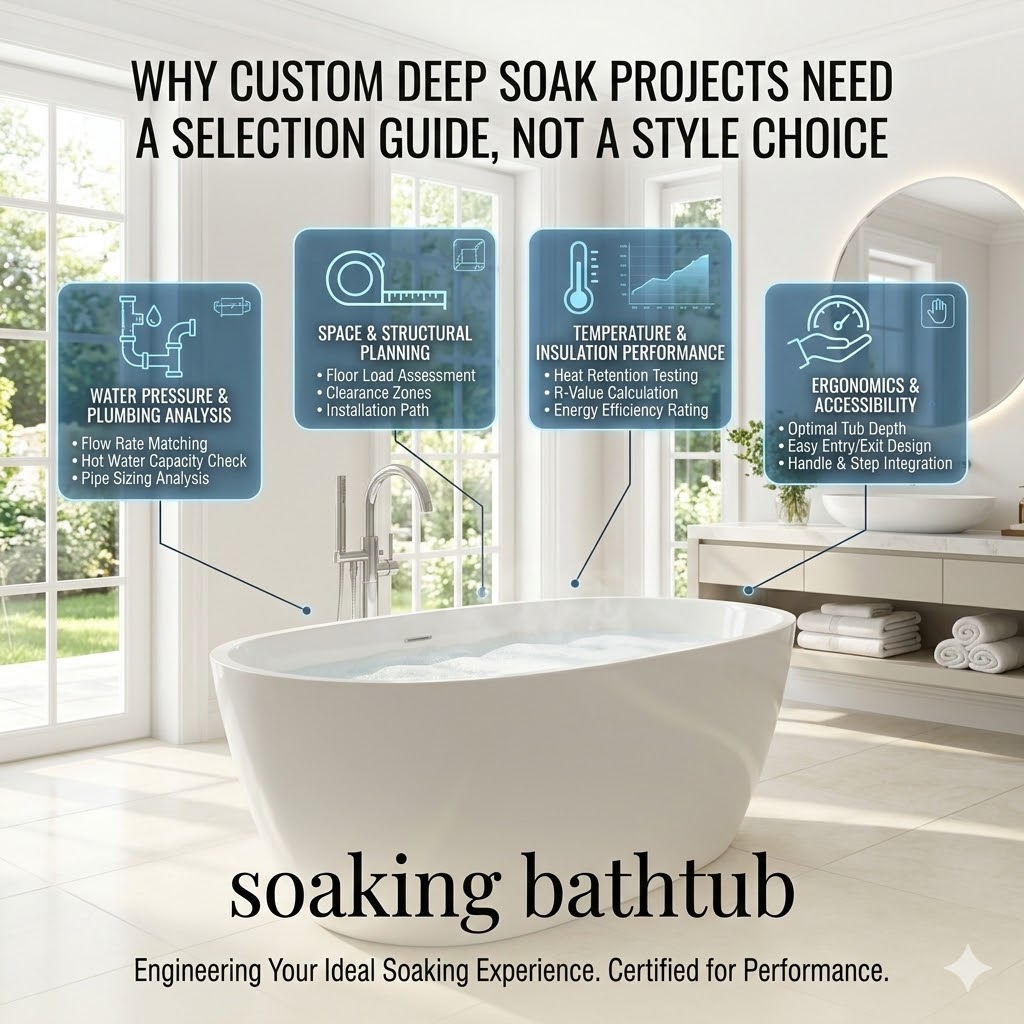
Why Custom Deep Soak Projects Need a Selection Guide, Not a Style Choice
Choosing a standard bathtub is often a “looks + size” decision. A deep soaking bathtub custom request is different because “deeper” is not a visual upgrade—it is a structural and installation change that alters how the product behaves over years of use.
More depth means more water volume. More water volume means higher static load, more pressure on tall side panels, and stronger requirements for base support and thermal stability. If the supplier only modifies shape without recalculating structure, the project pays later—through flex, noise, seal failures at the wall line, or surface stress cracks that show up after handover.
Use this guide to lock the critical specs early, before drawings become expensive to change.
Step 1: Choose Depth by Load Reality, Not by Guesswork
Depth drives load. And load drives everything else.
A practical selection range (used widely in projects) looks like this:
-
Comfort-focused residential deep soak: 500–600 mm
-
Compact bathrooms (vertical optimization): 450–500 mm
-
Hospitality where cleaning frequency is high: 480–550 mm
-
Elder-friendly or easy-entry needs: avoid extreme rim height; focus on ergonomic back angle instead
Engineering shortcut you can use in selection meetings:
Every extra 50 mm of water depth often increases filled-water load by roughly 12–18% (varies by internal geometry). That is why “just make it deeper” without reinforcement planning is risky.
Step 2: Confirm the Supplier’s Structural Logic (What They Reinforce, and Why)
For deep-soak designs, three zones matter most:
-
Upper side panels
Higher waterline increases lateral pressure. If thickness distribution is uniform and thin, deformation risk rises. -
Base + floor contact system
Deep tubs concentrate load at the base. Point-contact bases or uneven support amplify flex and noise. -
Entry/exit stress points
Users step in at the same location repeatedly. Without targeted reinforcement, micro-flex accumulates over time.
A reliable deep soaking bathtub custom approach should show clear structural intent, not marketing phrases. Ask the supplier to explain—plainly—how the load transfers from the bathing surface to the floor, and where they prevent stress concentration.
Step 3: Match Installation Conditions Before You Approve the Shape
Most project issues are installation-interface problems, not “material problems.”
Confirm these items early:
-
Drain/overflow positioning: fixed plumbing limits should drive geometry decisions
-
Wall interface strategy: is it freestanding, back-to-wall, alcove, or drop-in? Each has different tolerance needs
-
Support method: mortar bed / full-contact base / adjustable feet—each impacts long-term stability differently
-
Access planning: how will future drain service be handled after finishing?
For renovation projects, the selection should prioritize “fit and serviceability” over “unique profile.” A beautiful tub that forces drain relocation often becomes the most expensive line item in the room.
Step 4: Engineer Comfort: Ergonomics Beats “More Water”
Deep soaking comfort is not just depth. It’s body support.
Key ergonomic parameters buyers can actually specify:
-
Backrest angle: commonly comfortable ranges are 110°–125°
-
Lumbar curve continuity: avoids pressure points during longer soaks
-
Seat/hip zone geometry: controls sliding and posture fatigue
-
Rim height + entry feel: critical for safety and perceived usability
A well-designed deep tub can feel luxurious at 520 mm, while a poorly shaped 600 mm tub can feel awkward within minutes. This is why a deep soaking bathtub custom decision must evaluate internal geometry, not only external style.
Step 5: Manufacturing Control for Custom Orders (Where “Good Samples” Often Fail)
Custom projects fail when the first sample is strong, but production drifts.
Use measurable controls—this is where suppliers separate.
| Control Item | Practical Reference Range in Projects | What to Ask the Supplier | Why It Matters |
|---|---|---|---|
| Wall thickness tolerance | ±0.4–0.8 mm | “What’s your batch thickness tolerance?” | Reduces deformation and stress hot-spots |
| Base support coverage | 80–95% | “Is the base full-contact or point support?” | Higher coverage reduces flex/noise risk |
| Dimensional deviation per batch | ≤2–5 mm | “How do you control mold variation?” | Prevents fit issues with walls/frames |
| Static load design target | 320–380 kg+ | “What load do you design for?” | Deep water + user load needs margin |
| Surface chemical resistance | project-dependent | “What cleaners are acceptable?” | Daily cleaning can accelerate surface aging |
Decision tip: If a supplier can’t describe their thickness control and base support logic in concrete terms, treat “custom” as a styling offer, not an engineering capability.
Step 6: Verify Durability Under Thermal Cycling and Daily Use
Deep soaking means longer hot-water exposure, which amplifies thermal expansion/contraction cycles. That’s where micro-deformation begins if the structure is marginal.
Ask for evidence of:
-
Repeated hot–cold cycling considerations in design
-
Reinforcement placement that prevents “panel breathing”
-
Base geometry that avoids stress concentration when the tub expands slightly
This step is especially important for hospitality or heavy-use homes.
Step 7: Separate What Can Change vs What Must Stay Constant
A professional supplier should clearly separate:
Customizable (safe to change)
-
External profile and visual proportions
-
Rim detailing and surface finish
-
Internal styling within ergonomic limits
Structural constants (must remain stable)
-
Thickness distribution logic
-
Reinforcement layout
-
Base support geometry and load paths
This is the core rule that keeps customization from becoming long-term risk.
Common Buyer Questions
Q1: Is “deeper” always better for soaking comfort?
No. Beyond a point, added depth increases load and water use without improving ergonomics. Comfort is driven more by internal posture geometry than maximum depth.
Q2: What’s the most common failure mode in deep-soak custom projects?
Long-term flex and stress accumulation—usually caused by weak base support or poorly planned thickness distribution, not by “bad acrylic” alone.
Q3: Can custom deep soaking tubs work in compact bathrooms?
Yes. Vertical optimization works well when base support is engineered for stability and the internal geometry is designed for seated comfort.
Aoclea Custom Deep Soak Solutions for Projects
Aoclea supports project buyers who want deep-soak comfort without instability. For every deep soaking bathtub custom request, we align depth and internal geometry with load-bearing design, base support strategy, and installation constraints—so the finished bathroom remains quiet, stable, and serviceable over time.
Explore our bathtub solutions and manufacturing capabilities on our homepage:
https://www.aoclear-bath.com/
If you have a project drawing, target depth, or installation constraints (plumbing positions, wall type, platform type), our team can help translate them into a manufacturable specification package. Contact us here:
https://www.aoclear-bath.com/contact-us