
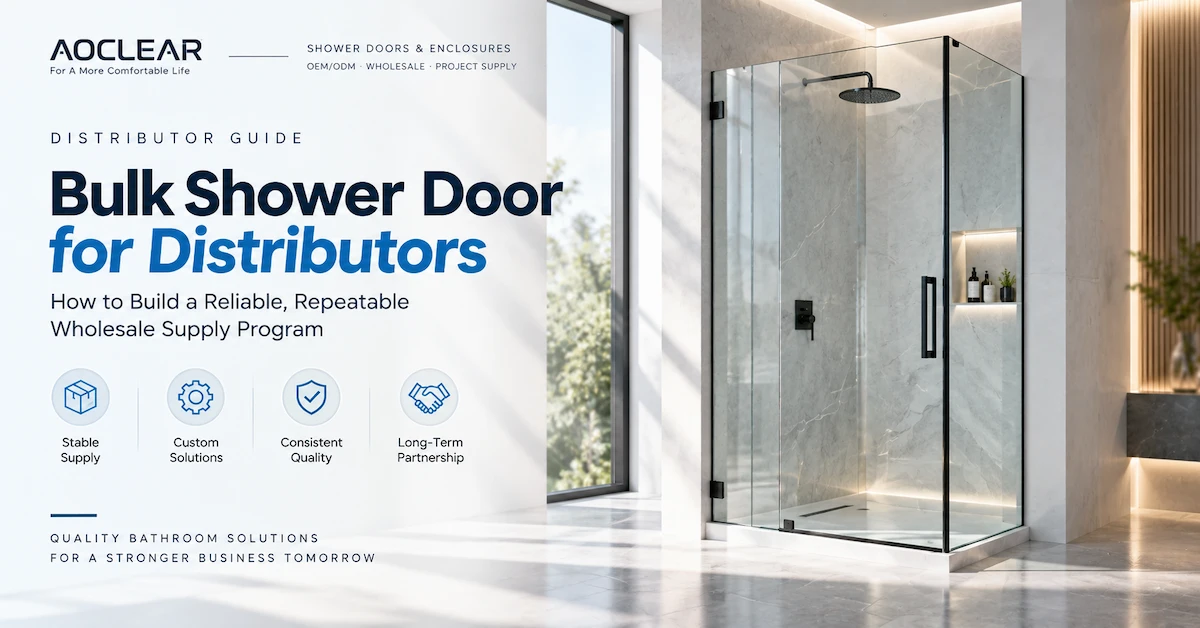
What Should Distributors Look for When Buying Shower Doors in Bulk?
For distributors, buying shower doors in bulk is not simply a larger version of a normal product order.
A distributor may sell the same shower door program to bathroom retailers, contractors, residential developers, hotel suppliers, e-commerce channels, and regional dealers. If a product changes unexpectedly between shipments, arrives with inconsistent finishes, or lacks replacement components, the problem can spread across dozens of downstream customers.
That makes repeatability just as important as initial product quality.
A strong bulk shower door supply program should give distributors control over five areas:
-
Product range and SKU strategy
-
Glass, profile, and hardware specifications
-
Batch-to-batch consistency
-
Packaging, branding, and logistics
-
Replenishment and replacement-part continuity
Distributors evaluating new suppliers should therefore compare complete supply systems rather than only FOB or unit pricing.
AOCLEAR's current shower doors and enclosures range covers shower doors, complete shower enclosures, and walk-in screens for different bathroom layouts and channel requirements.
Why Distributor Purchasing Is Different From Project Purchasing
A construction project normally has a defined quantity, delivery schedule, room type, and installation specification.
Distribution is different.
A distributor may need to replenish the same product over several years while supplying buyers with different bathroom dimensions, design preferences, and price expectations.
That creates a different set of priorities.
| Project Buyer Priority | Distributor Priority |
|---|---|
| One project specification | Repeatable product program |
| Fixed project quantity | Ongoing replenishment |
| Site-specific dimensions | Marketable size range |
| Project installation schedule | Inventory turnover |
| One finish package | Multiple finish options |
| Handover and completion | Long-term after-sales support |
| Project documentation | Sales and product documentation |
| Site spare parts | Long-term replacement components |
For distributors, the most attractive shower door is not necessarily the most technically complex model.
It is usually the product that combines market demand, reliable manufacturing, manageable inventory, clear positioning, and repeatable supply.
Start With a Distributor-Friendly Product Mix
One of the most common bulk purchasing mistakes is building too many SKUs too early.
Every additional width, glass style, opening mechanism, frame configuration, and hardware finish increases:
-
Inventory investment
-
Warehouse space
-
Forecasting complexity
-
Spare-parts requirements
-
Packaging variations
-
Slow-moving stock risk
A better approach is to build a product range in layers.
Core Volume Models
These are the configurations expected to generate the majority of turnover.
Depending on the target market, they may include:
-
Sliding shower doors
-
Hinged shower doors
-
Pivot doors
-
Framed systems
-
Semi-frameless systems
-
Common clear-glass configurations
-
Standard chrome, black, or brushed finishes
These products should be relatively easy to explain, stock, replace, and reorder.
Premium Models
Premium lines can use:
-
Frameless construction
-
Thicker glass
-
Reduced visual hardware
-
Premium handles and hinges
-
Easy-clean glass options
-
Higher-end finishes
They can help distributors serve hotels, luxury residential projects, showrooms, and design-focused retailers without forcing the entire range into a premium price tier.
Application-Specific Models
Depending on customer demand, a distributor may also need:
-
Walk-in shower screens
-
Compact corner solutions
-
Sliding systems for limited-clearance bathrooms
-
Custom-width programs
-
Shower enclosures for project customers
The key is not to carry every possible configuration.
The goal is to identify the smallest product architecture that can satisfy the largest share of the distributor's real customer base.
Framed, Semi-Frameless, or Frameless: Which Is Better for Distribution?
There is no single best structure for every distribution market.
Each format serves a different commercial position.
| Structure | Main Advantage | Distributor Consideration | Typical Position |
|---|---|---|---|
| Framed | Structural support and adjustment flexibility | Easier entry-price positioning | Volume / practical |
| Semi-frameless | Balance of design and support | Broad market appeal | Mid-range |
| Frameless | Minimal premium appearance | Greater dependence on glass, hardware, and accurate installation | Premium |
A framed shower door can be easier to position in cost-sensitive or high-volume channels.
A semi-frameless system often offers a useful balance between contemporary styling and installation tolerance.
A frameless system may achieve a stronger showroom effect, but the distributor should pay closer attention to glass specification, hinge loading, wall condition, installation accuracy, and service support.
AOCLEAR's custom shower door program supports different frame styles, opening mechanisms, glass choices, hardware arrangements, and branded configurations for OEM/ODM buyers.
Glass Specification Is a Commercial Decision, Not Just a Technical One
Glass strongly influences product positioning, shipping weight, hardware selection, packaging, and customer perception.
Distributors should define at least:
-
Glass type
-
Glass thickness
-
Glass finish
-
Safety requirements
-
Edge treatment
-
Coating requirements
-
Compatible hardware
Common aesthetic options can include clear, frosted, patterned, and low-iron glass depending on the product program.
Glass thickness should not be selected independently from the door structure.
A framed door can use the surrounding profile system for support, while a frameless door relies more heavily on glass rigidity, hinges, brackets, and installation geometry.
For this reason, a distributor should avoid comparing two quotations only by asking:
“How many millimeters is the glass?”
A better question is:
“How are the glass, hardware, profile structure, and door dimensions engineered to work together?”
That gives buyers a more meaningful basis for comparing different suppliers.
Hardware Quality Can Decide Whether a Distributor Gets Repeat Orders or Complaints
Glass attracts attention in a showroom.
Hardware often determines long-term customer satisfaction.
Key components can include:
-
Hinges
-
Rollers
-
Tracks
-
Brackets
-
Handles
-
Wall profiles
-
Fasteners
-
Magnetic seals
-
Bottom seals
-
Guide components
For a distributor, hardware standardization has an additional advantage: serviceability.
If every model uses completely different rollers, seals, screws, handles, or brackets, after-sales management becomes difficult.
A more controlled component strategy can simplify:
-
Replacement inventory
-
Warranty handling
-
Customer support
-
Dealer training
-
Repeat ordering
Distributors should ask whether replacement components can remain available after the original shipment.
This can be more important to a long-term distribution business than saving a small amount on the original unit cost.
Batch Consistency Is More Important Than a Perfect First Sample
A showroom sample may look excellent.
That does not automatically mean a supplier can reproduce the same product reliably over multiple bulk orders.
For distributors, the real test is whether later production can maintain the approved:
-
Glass specification
-
Overall dimensions
-
Profile geometry
-
Hardware structure
-
Surface finish
-
Sealing system
-
Packaging method
-
Branding details
Unexpected specification changes are particularly risky.
For example, changing a roller, hinge, profile, or finish without proper approval may create incompatibility with existing inventory or replacement parts.
For buyers managing repeat purchasing, specification control should therefore continue after the first order.
A useful sourcing principle is:
Approve the product once, but control the specification continuously.
For a deeper look at this issue, see AOCLEAR's guide to high-consistency shower door supply.
What Quality Control Should Distributors Ask About?
A distributor does not need to perform every factory inspection personally, but the purchasing specification should define what needs to be controlled.
Glass Inspection
Check for:
-
Correct dimensions
-
Edge condition
-
Visible surface defects
-
Hole and cut-out position
-
Required glass specification
Hardware Inspection
Check:
-
Hinge or roller operation
-
Component completeness
-
Finish consistency
-
Fastener compatibility
-
Assembly fit
Door Alignment
The system should open, close, and align correctly with the intended frame or hardware configuration.
Water Containment
Seals, overlaps, bottom components, and door geometry should be evaluated as a system rather than as independent parts.
Visual Finish
For distributor inventory, visible variation can create problems even when the product remains functional.
Chrome, black, brushed, or other finishes should remain visually consistent within the approved product program.
AOCLEAR's shower manufacturing system integrates glass processing, hardware assembly, and water-tightness inspection within its shower product workflow. Buyers can review the wider shower door product range when defining suitable configurations.
Packaging Is Part of the Product for Distributors
For distribution channels, packaging performs more functions than transport protection.
It must also support:
-
Warehouse identification
-
Retail handling
-
Dealer delivery
-
Model recognition
-
Installation accuracy
-
Brand presentation
A good bulk shower door package should make it obvious which components belong together.
Depending on the distribution program, useful packaging controls can include:
-
Model identification
-
Size identification
-
Hardware set identification
-
Left/right configuration where applicable
-
Installation instructions
-
Barcode or distributor label
-
Private-label artwork
-
Spare-parts identification
Glass products are also particularly sensitive to poor handling during international transport.
Packaging design should therefore consider the entire route:
Factory → container → importer warehouse → dealer → contractor → installation site
A package that survives factory inspection but fails during local distribution is not an effective export package.
Private Label and OEM Options Can Protect Distributor Margins
A distributor selling only generic products may compete directly with many other suppliers.
OEM and private-label development can create stronger channel differentiation.
Possible customization areas include:
-
Product dimensions
-
Glass configuration
-
Frame structure
-
Opening mechanism
-
Hardware style
-
Hardware finish
-
Profile color
-
Handles
-
Logo
-
Cartons
-
Labels
-
Instructions
-
Product naming
A private-label program does not always need a completely new shower door.
In many cases, the more practical approach is to standardize the proven engineering platform while customizing selected visible and commercial elements.
This can help balance:
-
Development cost
-
Product differentiation
-
Manufacturing stability
-
Replacement-part compatibility
-
Time to market
Distributors planning their own collection can review AOCLEAR's OEM and custom shower door options.
How Should Distributors Think About MOQ and Inventory?
The lowest MOQ is not automatically the best commercial arrangement.
If a supplier allows very small quantities across dozens of configurations, the distributor may still end up with an inefficient product range.
Instead, evaluate MOQ together with:
-
Expected monthly sales
-
Number of SKUs
-
Reorder frequency
-
Warehouse capacity
-
Container utilization
-
Seasonal demand
-
Lead time
-
Safety stock
A distributor might achieve better inventory efficiency by concentrating volume into six well-selected SKUs than by carrying twenty-five slow-moving variations.
The right sourcing conversation should therefore include both manufacturing MOQ and commercial SKU planning.
Before confirming quantities, distributors should ask the manufacturer to quote based on the actual model mix rather than assuming one MOQ applies equally to every configuration.
Repeat Supply Matters More Than the First Shipment
For distributors, supply reliability should be evaluated over multiple purchasing cycles.
Questions worth asking include:
-
Can the same model be reordered later?
-
Can the same hardware specification be maintained?
-
How are engineering changes controlled?
-
Can replacement rollers, seals, and handles be supplied?
-
Can packaging remain consistent?
-
Can different finishes be consolidated?
-
How are repeat orders referenced to previous specifications?
-
What information must be reconfirmed before production?
These questions reveal whether the manufacturer is prepared for a distribution relationship or is simply focused on winning the first purchase order.
AOCLEAR positions its shower door business around wholesalers, distributors, OEM/ODM brands, retailers, builders, and project buyers. More company manufacturing information is available on the AOCLEAR About Us page.
Common Risks When Sourcing Bulk Shower Doors
Price differences between suppliers are easy to see.
Supply-chain risks are less obvious.
| Risk | Distributor Impact | What to Control |
|---|---|---|
| Finish variation | Mixed-looking inventory | Approved finish reference |
| Hardware substitutions | Spare-parts incompatibility | Frozen component specification |
| Dimension variation | Installation complaints | Drawing and inspection control |
| Weak packaging | Breakage and claims | Export packaging specification |
| Too many SKUs | Slow inventory | Range rationalization |
| Unclear certifications | Market-entry risk | Confirm required market documents |
| Poor spare-parts support | Higher warranty cost | Replacement-part plan |
| Unstable repeat supply | Lost dealer confidence | Long-term specification management |
These risks explain why distributors should avoid making a sourcing decision based only on quoted unit price.
A slightly cheaper product can become more expensive if it generates higher breakage, returns, warranty claims, stock fragmentation, or replacement-part problems.
Certification Requirements Should Be Confirmed by Product and Market
Shower door requirements vary by target country and application.
Distributors should identify the required standards before finalizing a product rather than assuming that one certification package applies globally.
The purchasing team should confirm:
-
Destination market
-
Safety-glass requirements
-
Product configuration
-
Installation environment
-
Required test reports or certificates
-
Labeling requirements
-
Import documentation
AOCLEAR's website lists multiple international compliance systems across its bathware business, but certification should still be verified for the specific model and destination market before purchase.
This is especially important when a distributor serves several countries under one product portfolio.
What Information Should a Distributor Send Before Requesting a Quote?
A detailed RFQ usually produces a more useful quotation than simply sending:
“Please quote 500 shower doors.”
A better RFQ includes:
-
Target country or region
-
Buyer channel
-
Expected annual or initial quantity
-
Door type
-
Framed / semi-frameless / frameless preference
-
Required dimensions
-
Glass specification
-
Opening mechanism
-
Profile material and finish
-
Hardware finish
-
Packaging requirement
-
Private-label requirement
-
Certification requirement
-
Desired delivery schedule
-
Replacement-part expectations
If several models are required, include estimated quantity per SKU.
This allows the manufacturer to evaluate production, packaging, component sourcing, and pricing more accurately.
When Is Bulk Shower Door Supply Not the Right Strategy?
A bulk distribution program is most effective when the buyer has repeatable demand.
It may be less suitable when:
-
Every customer requires a completely different custom opening
-
Sales volume is still highly uncertain
-
The target market has not been validated
-
The distributor cannot support glass-product warehousing
-
Product positioning has not been defined
-
Certification requirements are still unclear
In those cases, a smaller pilot program or limited model range may be more practical.
Distributors should validate demand before expanding the number of models.
FAQ: Bulk Shower Door for Distributors
What shower door types are most suitable for distributors?
There is no universal answer. Sliding, hinged, framed, semi-frameless, frameless, and walk-in products serve different price points and bathroom layouts. The best starting range is usually the smallest group of models that covers the distributor's main customer segments.
Should distributors choose framed or frameless shower doors?
Framed systems can offer practical support and broader entry-level positioning, while frameless designs provide a more premium visual appearance. Many distributors benefit from carrying both rather than relying on one structure.
Can shower doors be private labeled?
Yes. Depending on the manufacturing program, customization may include logos, cartons, labels, instructions, dimensions, glass configurations, hardware, finishes, and other product details.
How important are spare parts for wholesale shower doors?
Very important. Rollers, seals, handles, hinges, and related hardware may need replacement during the product lifecycle. Long-term spare-parts planning can reduce warranty and service problems.
Should distributors ask for samples before a bulk order?
Samples or approved pre-production configurations are useful for confirming appearance, function, packaging, and specification before a larger production run. The approved specification should then be clearly documented.
How can distributors reduce shower door inventory risk?
Limit unnecessary SKUs, select configurations based on actual market demand, plan reorder cycles, standardize components where possible, and review container and warehouse efficiency before expanding the range.
What should distributors confirm about certifications?
Confirm the required standard for the specific destination market and product configuration. Do not assume every certificate applies to every shower door or every country.
What is the most important factor when choosing a bulk shower door supplier?
For long-term distribution, consistency is usually more valuable than a one-time low price. The supplier should be able to reproduce approved specifications, support repeat orders, maintain packaging and components, and provide clear communication when changes are necessary.
Building a Long-Term Shower Door Distribution Program
A successful wholesale program depends on more than finding an attractive shower door.
Distributors need a product system that can be stocked, explained, sold, reordered, serviced, and expanded without creating unnecessary complexity.
Before approving a supplier, evaluate the complete commercial chain:
Product strategy → specification → manufacturing → QC → packaging → shipping → inventory → sale → installation → after-sales → replenishment
This approach helps turn bulk purchasing into a repeatable distribution model rather than a series of disconnected orders.
For buyers developing a wholesale, OEM, or private-label shower door range, AOCLEAR provides shower door and enclosure manufacturing support across product configuration, glass and hardware options, branding, packaging, and repeat supply. You can review AOCLEAR's custom shower door capabilities or contact the AOCLEAR team with your target market, product mix, estimated quantities, and customization requirements.
Conclusion
For distributors, a successful bulk shower door program depends on more than achieving a competitive unit price. The stronger long-term strategy is to control the SKU mix, product specifications, glass and hardware consistency, packaging, spare parts, and repeat-order continuity from the beginning.
If you are planning a wholesale or private-label shower door range, you can review AOCLEAR's custom shower door solutions or contact AOCLEAR to discuss your target market, product mix, estimated order quantities, branding requirements, and replenishment plan.