
What Should Buyers Expect From a Frameless Shower Door Supplier?
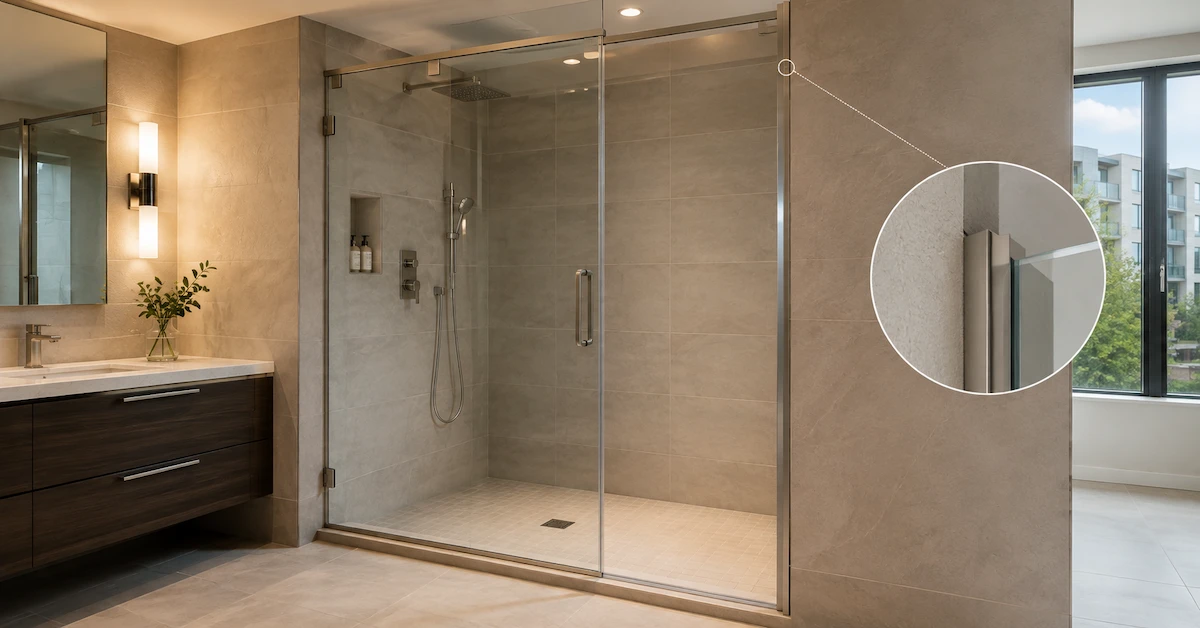
A professional frameless shower door supplier should do more than provide a large sheet of tempered glass with a hinge and handle. In a frameless system, the glass itself becomes an important structural element because there is less continuous framing around the perimeter to compensate for inaccurate dimensions, weak hardware selection, or poor installation conditions. Buyers therefore need to evaluate the complete relationship between glass size, panel weight, hinges or brackets, wall fixing, seals, threshold conditions, opening direction, and actual bathroom geometry. AOCLEAR’s current shower door range includes frameless, semi-frameless, and framed structures together with hinged, pivot, sliding, and bi-fold mechanisms, while the custom shower door service provides additional options for glass treatment, hardware finish, dimensions, and accessories. For hotel, apartment, retail, or private-label sourcing, the first objective should therefore be to turn the desired visual concept into a controlled technical specification before asking several suppliers for prices.
Who Actually Needs a Frameless Shower Door Supplier?
A frameless shower door supplier is especially relevant to hotel procurement teams that need the same finished appearance across many rooms, property developers working with repeatable apartment layouts, contractors coordinating doors with tiled openings and shower bases, distributors building a defined shower-door assortment, and bathroom brands developing an OEM or private-label range. Frameless construction may also suit boutique hospitality and premium residential projects where visual openness and reduced framing are important design objectives. It is not automatically the best solution for every bathroom, however. Projects with difficult wall conditions, large dimensional variation, unusual structural support, tight budgets, or specific adjustment requirements may benefit from semi-frameless or framed systems instead. Buyers should therefore start with the application and installation condition rather than deciding that “frameless” is automatically the highest-quality answer. AOCLEAR positions its shower products for residential, hospitality, commercial, contractor, developer, distributor, and brand customers, making application-based selection more useful than a single universal specification.
Start With Finished Opening Measurements, Not a Catalog Size
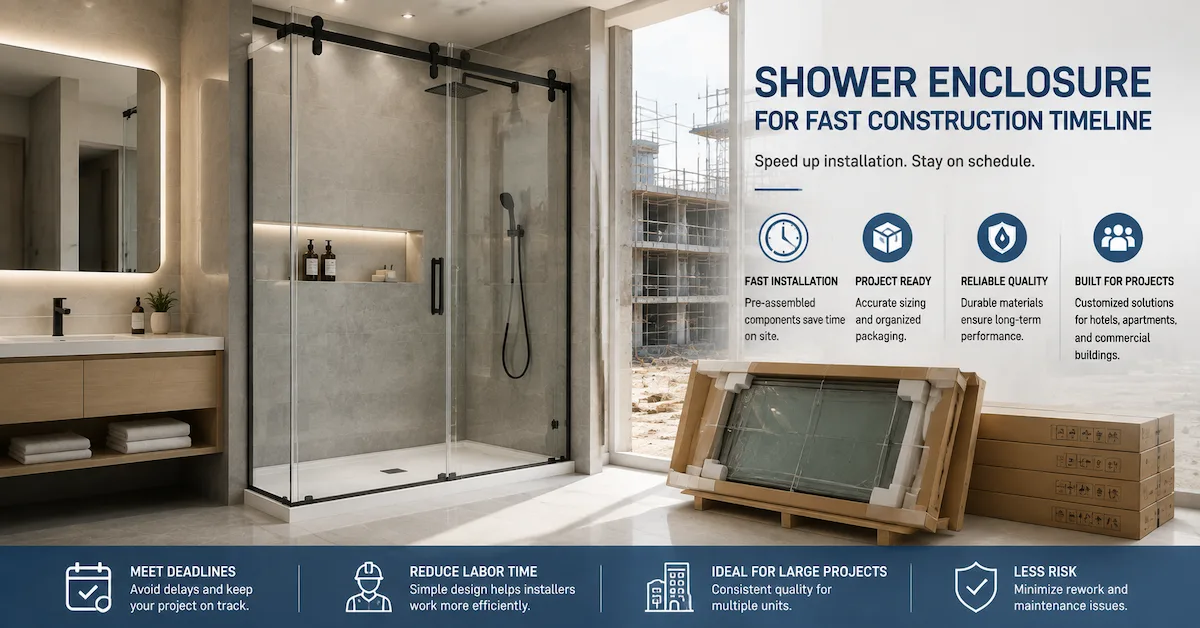
One of the highest-risk purchasing mistakes is requesting a custom frameless shower door from a rough construction dimension rather than the finished opening. Tile, wall panels, waterproofing build-up, shower curbs, and other finishing work can change the usable opening, while walls that are not perfectly plumb may create different dimensions at the top, middle, and bottom. AOCLEAR’s custom shower door measurement guide specifically asks buyers to measure opening width at three points, record the opening height, check wall plumb, measure curb or threshold height, and record wall thickness. For project orders, the drawing should also identify which side is fixed, which side opens, whether the door swings inward or outward where applicable, nearby sanitary fixtures, and the location of any fixed glass panel. A reliable frameless shower door supplier should be able to tell the buyer which site information is still missing before glass is released for processing; manufacturing glass first and resolving dimensional uncertainty during installation transfers factory risk directly to the construction site.
Build a Controlled Specification Before Comparing Quotations
A quotation becomes useful only when suppliers are pricing the same scope. Instead of sending a photograph and requesting “100 frameless shower doors,” create a specification that distinguishes confirmed requirements from items requiring supplier recommendation. The following table is a procurement checklist rather than a set of fixed AOCLEAR model parameters, because actual dimensions, hardware loads, glass configurations, and tolerances need confirmation for the selected door.
| Specification Area | What the Buyer Should Define or Confirm | Why It Matters |
|---|---|---|
| Finished opening | Width at several heights, total height, wall plumb | Determines glass geometry |
| Door layout | Single door, door plus fixed panel, corner arrangement | Defines panel and hardware configuration |
| Opening mechanism | Hinged, pivot, sliding, bi-fold if applicable | Affects clearance and component selection |
| Glass | Thickness, clear/frosted/patterned/low-iron, treatment | Influences appearance, weight, and specification |
| Hardware | Hinges, brackets, handle, support components | Controls movement and structural support |
| Finish | Chrome, brushed, black, gold, or approved custom finish | Controls project appearance consistency |
| Sealing | Bottom sweep, side seal, magnetic seal where applicable | Influences water management |
| Threshold/base | Curb, shower tray, or floor relationship | Affects installation and splash control |
| Installation adjustment | Allowable site variation and fixing conditions | Important for repeat project installation |
| Supply scope | Glass, hardware, seals, fixing kit, handle, accessories | Prevents quotation gaps |
| Packaging | Glass protection, hardware identification, labels | Reduces logistics and site confusion |
| Documentation | Drawings, installation guide, packaging list | Supports approval and installation |
Glass Thickness Is a System Decision, Not a Quality Score
Buyers frequently compare frameless shower doors by asking whether a supplier uses “thicker glass,” but thickness alone does not prove that one system is better. The selected glass must work with the panel dimensions, door weight, hinge or pivot design, support hardware, opening frequency, and fixing condition. AOCLEAR’s current custom shower door page lists 6–10 mm tempered glass for its frameless, semi-frameless, and framed customization directions, while the general shower-door product page also states 6–10 mm tempered safety glass as an available range. That means buyers should request the actual thickness for the proposed configuration rather than assuming one thickness applies to every frameless design. The same principle applies when comparing suppliers: a frameless shower door supplier should explain the proposed glass and hardware combination for the specific panel dimensions instead of presenting thickness as an isolated marketing number.
Glass Type Should Follow the Project’s Design and Maintenance Requirements
AOCLEAR currently lists clear tempered glass, frosted glass, patterned glass, and low-iron glass within its custom shower door options. Clear glass supports maximum visual openness, frosted glass changes privacy and light transmission, patterned glass introduces a decorative surface, and low-iron glass reduces the greenish tint typically visible in standard clear glass. For a hotel chain or private-label assortment, the decision should not be made from rendered images alone; approve a physical sample or agreed visual standard where color and clarity are commercially important. Buyers should also clarify whether any coating is included in the quoted configuration, what maintenance instructions apply, and whether the finish or coating changes when the order is repeated. A good specification records the glass type and any approved treatment as separate line items so that future purchasing teams can reproduce the same door rather than relying on a product name that may contain several optional configurations.
Hardware Is the Hidden Structure of a Frameless Door
Because a frameless design reduces continuous framing, hinges, brackets, handles, support bars, sliding components where applicable, and wall fixing become especially important. Hardware needs to support the actual glass geometry and repeated movement while maintaining alignment, and its finish needs to remain visually consistent across the project. AOCLEAR’s shower door product information describes heavy-duty hinges or sliding mechanisms, corrosion-resistant hardware, seals, handles, and optional accessories, while its custom page identifies stainless-steel hardware and adjustable roller systems for relevant sliding configurations. When evaluating a frameless shower door supplier, ask for the hardware specification or controlled component list used for the approved sample. If the hinge, bracket, handle, or finish changes between production batches, the buyer should know whether the change requires approval. This is particularly important for hotel rooms and private-label retail programs where a small hardware change can be clearly visible even when the glass dimensions remain unchanged.
Water Management Depends on More Than a Seal
A frameless appearance does not eliminate the physical requirement to control shower water. Door orientation, panel overlap, bottom clearance, threshold geometry, floor slope, shower-head position, seals, and the direction in which water is sprayed all influence actual performance. AOCLEAR lists magnetic seals and bottom sweeps among its custom shower-door water-management features, but buyers should avoid treating the word “watertight” as proof that every open or frameless layout can prevent every drop of water from escaping under every installation condition. For a hotel or apartment project, review the entire wet-area layout together with the door drawing and installation method. Where strong water containment is more important than an open visual design, it may also be useful to compare an individual door with a complete shower enclosure solution. A capable frameless shower door supplier should help distinguish a product feature from a site-dependent performance condition rather than allowing the buyer to discover that distinction after installation.
Frameless vs Semi-Frameless vs Framed: Which Should Buyers Choose?
The appropriate configuration depends on aesthetics, project tolerance, installation conditions, hardware strategy, and budget rather than a simple quality ranking. AOCLEAR’s present customization range includes all three structural approaches, so procurement teams can first compare the architecture and then request current model or project-specific information.
| Door Structure | Main Characteristic | Typical Buyer Value | Key Point to Confirm |
|---|---|---|---|
| Frameless | Minimal continuous framing and exposed glass | Open, modern appearance for premium interiors | Glass, hardware, wall condition, adjustment |
| Semi-frameless | Partial framing combined with exposed glass | Balance between visual openness and structural support | Location of profiles and adjustment range |
| Framed | More continuous framing around the system | Practical structural support and broader project positioning | Profile design, finish, glass, installation condition |
The comparison table describes structural purchasing logic rather than claiming that every model has the same cost or installation tolerance. A specific quotation should still be based on an approved drawing and actual product configuration.
Quality Control Should Connect the Approved Sample to the Production Batch
The most useful quality-control question is not “Do you inspect your products?” but “How do you ensure that the delivered batch remains tied to the approved specification?” AOCLEAR states that its manufacturing system integrates glass selection and processing, aluminum or stainless-steel fabrication, assembly, functional testing, final inspection, and export packaging, while its shower-door product page describes a dedicated shower operation handling glass processing, hardware assembly, and leak testing. For buyers, these capabilities become meaningful when the purchasing specification defines what should be inspected: overall glass dimensions, hole or cut-out positions where applicable, edge condition, surface appearance, hardware finish, door movement, panel alignment, seals, accessory completeness, and packaging. The approved sample should be linked to a drawing revision and component specification so that a frameless shower door supplier is reproducing a documented configuration rather than simply manufacturing something that looks similar to an earlier sample.
Certification Claims Must Be Checked Against the Actual Product
AOCLEAR’s current custom shower-door page states that its tempered custom shower-door glass is ANSI Z97.1 certified, while broader company and product pages display additional standards and certification references. For procurement, the important step is to request the relevant report, certificate, declaration, or supporting document and check the product description, model coverage, issuing organization, test scope, and destination-market requirement before relying on a logo. This is particularly important for an OEM project because changing glass, hardware, dimensions, or another technical element may affect whether existing documentation still applies. Do not assume that every company-level certification applies automatically to every customized frameless shower-door configuration. A professional frameless shower door supplier should be able to discuss documentation at model or configuration level when compliance forms part of the buyer’s purchase requirement.
Production Capacity Matters Only When It Matches Your Order Schedule
AOCLEAR states that it was founded in 2005, operates two factories, employs more than 150 skilled workers, and integrates product development, glass processing, assembly, inspection, packaging, and international sales. Those company-level capabilities are useful when assessing supplier infrastructure, but buyers should still ask how their actual order will be scheduled. A hotel project with several room types may require samples, revised drawings, several hardware finishes, batch labels, and phased deliveries, while a distributor may prioritize stable repeat orders and mixed product ranges. Instead of asking only “What is your lead time?”, ask when the production clock begins, which approvals must be completed first, whether custom hardware affects preparation time, how inspections are scheduled, and whether delivery will be completed as one shipment or several batches. A frameless shower door supplier with strong capacity can still miss a project schedule if drawings, site measurements, component approvals, and packaging are not frozen before production.
Compare Total Procurement Risk, Not Only Unit Price
Two quotations can show the same product description while covering very different scopes.One may include the selected handle, brackets, seals, mounting hardware, custom carton labeling, and installation documentation; another may quote only the basic door assembly. Cost can also be affected by glass treatment, low-iron glass, special hardware finishes, custom dimensions, sample development, packaging upgrades, spare components, shipping method, and replacement logistics. For project procurement, dimensional errors can cost far more than a small difference in factory price because replacement glass may interrupt room completion and require additional handling or installation visits. A useful commercial comparison therefore separates the base product, optional features, custom development, packaging, freight terms, replacement strategy, and project-specific services. The lowest-priced frameless shower door supplier is not necessarily the lowest-cost supplier if unresolved specifications create rework after the order reaches the jobsite.
OEM and Private-Label Orders Need Revision Control
AOCLEAR’s OEM/ODM services and custom shower door program support customization involving dimensions, glass choices, frame style, opening mechanisms, hardware finishes, branding, and packaging. For private-label buyers, those options should be converted into one controlled production definition rather than handled through scattered emails and reference photos. Record the buyer product code, supplier reference, approved drawing revision, glass specification, hardware finish, handle or accessory choice, branding artwork, carton revision, installation documentation, and approval date. Structural changes should be distinguished from cosmetic changes because changing a glass panel size or door mechanism can require engineering review, while changing carton artwork follows a different approval process. The objective is to make the approved sample reproducible six or twelve months later when another purchasing manager places the repeat order.
How Can Hotel and Apartment Buyers Reduce Installation Risk?
For repeated-room projects, create a room-type matrix before mass production. Each bathroom type should be linked to a specific shower-door drawing, finished opening, hardware finish, and installation reference rather than allowing installers to decide which door belongs to which room after delivery. Where the construction sequence allows, a sample-room installation can reveal measurement, swing-clearance, water-management, and fixing issues before the full quantity is released. Packaging and labeling should then make the connection between the factory product and the project schedule obvious: glass panels, hardware kits, seals, and accessories need identification that prevents parts from several doors being mixed. A hotel-focused frameless shower door supplier should therefore be assessed not only on manufacturing appearance but also on its ability to support drawing control, batch consistency, packaging logic, and replacement requirements throughout the project.
What Should You Send When Requesting a Frameless Shower Door Quote?
A useful RFQ should include the project type, destination market, expected quantity, bathroom or opening drawing, finished dimensions if available, required door configuration, glass preference, hardware finish, opening direction, target installation schedule, branding requirements, packaging needs, and any documentation required by the destination market. If some dimensions have not yet been finalized, clearly identify them as preliminary rather than allowing them to become accidental production values. AOCLEAR provides dedicated shower door solutions, custom shower door development, and direct project inquiry through its Contact Us page. Sending a structured RFQ allows the factory to identify missing technical information before quotation and drawing approval instead of trying to reconstruct the project from a single reference image.
Frequently Asked Questions
1. What Should I Look for in a Frameless Shower Door Supplier?
Evaluate whether the supplier can translate finished opening dimensions into a controlled door specification, recommend an appropriate glass and hardware combination, provide drawings, manage glass processing and assembly, define meaningful inspection points, protect the product for shipment, and reproduce the same approved configuration on repeat orders. Factory size alone does not answer these questions; the production and approval process matters more.
2. What Glass Thickness Is Available for AOCLEAR Frameless Shower Doors?
AOCLEAR’s current custom shower-door page lists 6–10 mm tempered glass for its frameless customization direction. Final thickness should still be confirmed for the proposed door size, configuration, hardware, and project because thickness is part of the complete system rather than an independent upgrade. View AOCLEAR custom shower door options.
3. Is Frameless Better Than Semi-Frameless or Framed?
Not universally. Frameless systems minimize visual framing, while semi-frameless and framed structures introduce different levels of profile support and may suit different site conditions, budgets, or installation requirements. The right choice depends on the actual bathroom, design goal, and technical constraints.
4. What Measurements Are Needed for a Custom Frameless Shower Door?
At minimum, establish opening width at multiple heights, opening height, wall plumb, curb or threshold condition, and relevant wall dimensions. Also record fixed-panel positions, opening direction, nearby fixtures, and other conditions that could interfere with door movement. AOCLEAR provides these measurement points on its custom shower door page.
5. Can AOCLEAR Customize Hardware Finishes?
The current customization page lists several hardware finish directions, including polished chrome, brushed nickel, matte black, oil-rubbed bronze, and gold. Availability should be confirmed against the selected hardware system and order because the finish needs to match the actual components specified for production.
6. Can Frameless Shower Doors Be Used in Hotels?
Yes, frameless doors can be considered for hotel guest rooms and other hospitality applications, but the project team should evaluate room geometry, cleaning requirements, hardware operation, maintenance access, water management, replacement strategy, and batch consistency. A hotel specification should not be based on appearance alone.
7. How Should I Check Quality Before Shipment?
Define the inspection criteria before production. Depending on the configuration, buyers may review glass dimensions and appearance, hole and cut-out positions, edge condition, hardware finish, assembly alignment, door movement, seals, accessory completeness, packaging, and the relationship between the finished door and approved drawing. The exact inspection method should be agreed for the order.
8. Does AOCLEAR Support OEM or Private-Label Shower Doors?
AOCLEAR states that it supports OEM/ODM customization across dimensions, finishes, functions, branding, and packaging. For a private-label project, confirm which modifications apply to the selected door and document the final approved configuration before mass production. Review AOCLEAR OEM/ODM services.
9. How Long Does a Custom Frameless Shower Door Order Take?
There is no single reliable lead time for every project because the schedule can depend on drawing confirmation, site dimensions, sample requirements, glass configuration, hardware sourcing, finish selection, packaging, quantity, and shipping arrangements. Ask the supplier to provide a schedule tied to a clear approval milestone rather than relying on a generic production estimate.
10. How Do I Request a Frameless Shower Door Quote From AOCLEAR?
Prepare the intended application, quantity, destination market, bathroom drawings or dimensions, door configuration, glass preference, hardware finish, branding or packaging requirements, and target project timing. Submit the information through AOCLEAR Contact Us so the remaining technical details can be identified before final quotation and production approval.
Conclusion
Selecting a frameless shower door supplier is ultimately a decision about dimensional control, glass and hardware compatibility, quality consistency, installation readiness, and repeat-order risk rather than simply finding the lowest price or thickest glass. Hotel developers, contractors, distributors, and private-label brands should define the finished opening first, establish a controlled glass and hardware specification, agree how the approved sample will be reproduced during mass production, confirm documentation and packaging requirements, and make sure all unresolved site conditions are identified before glass processing begins. AOCLEAR combines shower-door manufacturing with OEM/ODM customization for residential, hospitality, and commercial projects; buyers can review its shower door range, study the custom shower door service, and submit project requirements with drawings, quantity, configuration, finish, market, and delivery requirements for project-specific confirmation.