
How Do You Develop a Custom Shower Door for Repeat Production?
Custom shower door product development should move through controlled gates: define the buyer and room, freeze the product brief, review design for manufacturing, approve drawings and samples, validate dimensions and performance, then release production with packaging and change control. A product image or a rough opening size is not enough to create a repeatable shower door. The supplier and buyer need one shared specification for glass, frame, opening mechanism, hardware, seals, finish, tolerances, inspection, documentation, and delivery scope.
This guide is for bathroom brands, importers, distributors, contractors, developers, hospitality teams, and private-label buyers who want to develop a new shower door or adapt an existing design. Its search intent is commercial investigation and RFQ preparation: deciding what information to send a manufacturer and what evidence to request before approving a sample or repeat order. That makes custom shower door product development a purchasing workflow, not just a design exercise.
The company and product facts in this article come from AOCLEAR's official pages. The development gates, measurement logic, CMM questions, tolerance examples, and approval recommendations are procurement guidance. AOCLEAR's published pages do not provide one universal tolerance table, CMM capability statement, MOQ, fixed lead time, or model-specific test report for every custom configuration, so those items remain project questions rather than assumed facts.
- Define the product: identify the opening, user environment, glass, structure, hardware, finish, and target market.
- Define the evidence: agree which drawings, samples, measurements, tests, certificates, photos, and inspection records are required.
- Define repeatability: control revisions, critical dimensions, packing, spare parts, and approved changes before the second order.
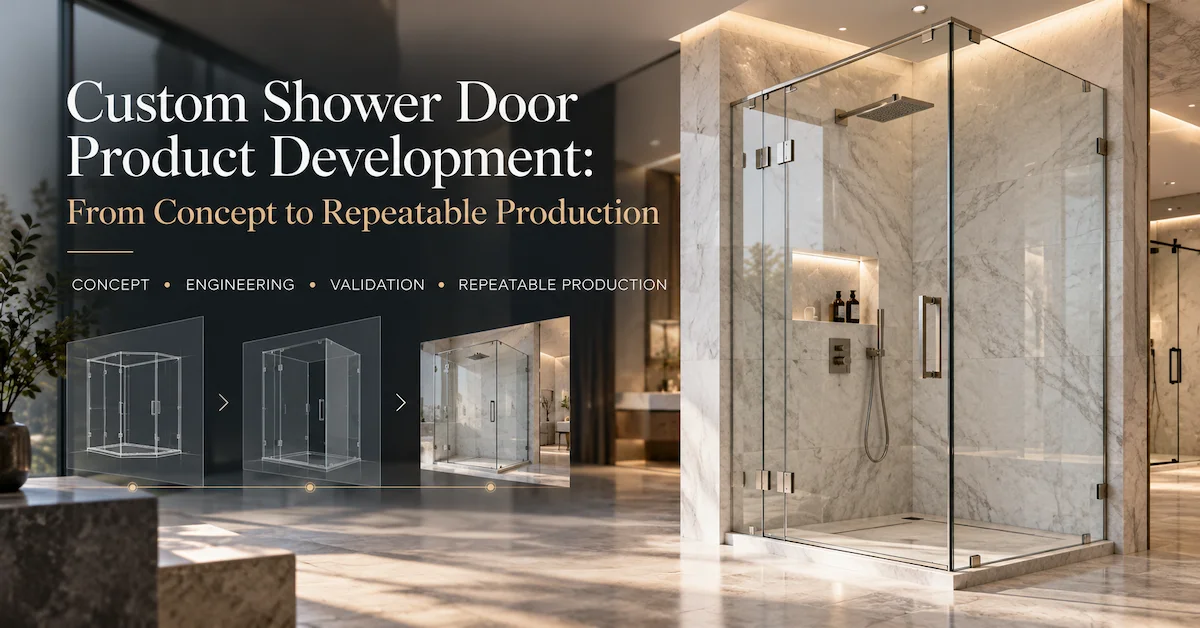
What Does Product Development Mean for a Shower Door?
For a shower door buyer, product development is the controlled conversion of a market idea into a defined, producible, inspectable, installable, and repeatable item. It is broader than choosing a style from a catalog and more specific than asking a factory for a custom size. The finished product must work as a system: glass must match the opening method, hinges or rollers must match the panel and support condition, seals must match the water direction, and the packing method must protect the same approved finish and hardware in transit.
A useful development file connects five layers:
| Layer | What to define | Why it matters |
|---|---|---|
| Market brief | Buyer, application, price position, target market, design language, quantity and launch timing | Prevents a visually attractive product from missing its commercial use |
| Engineering definition | Panel layout, glass, profiles, hinges or rollers, seals, handles, finish and installation interfaces | Creates a buildable product instead of an unpriced concept |
| Validation plan | Dimensional checks, operation, water management, appearance, safety and applicable documents | Shows what must be true before approval |
| Production control | Revision, critical-to-quality dimensions, inspection method, component references and packing | Keeps later units aligned with the approved sample |
| Lifecycle control | Spare parts, cleaning instructions, complaints, approved changes and revalidation triggers | Protects the product after launch and across repeat orders |
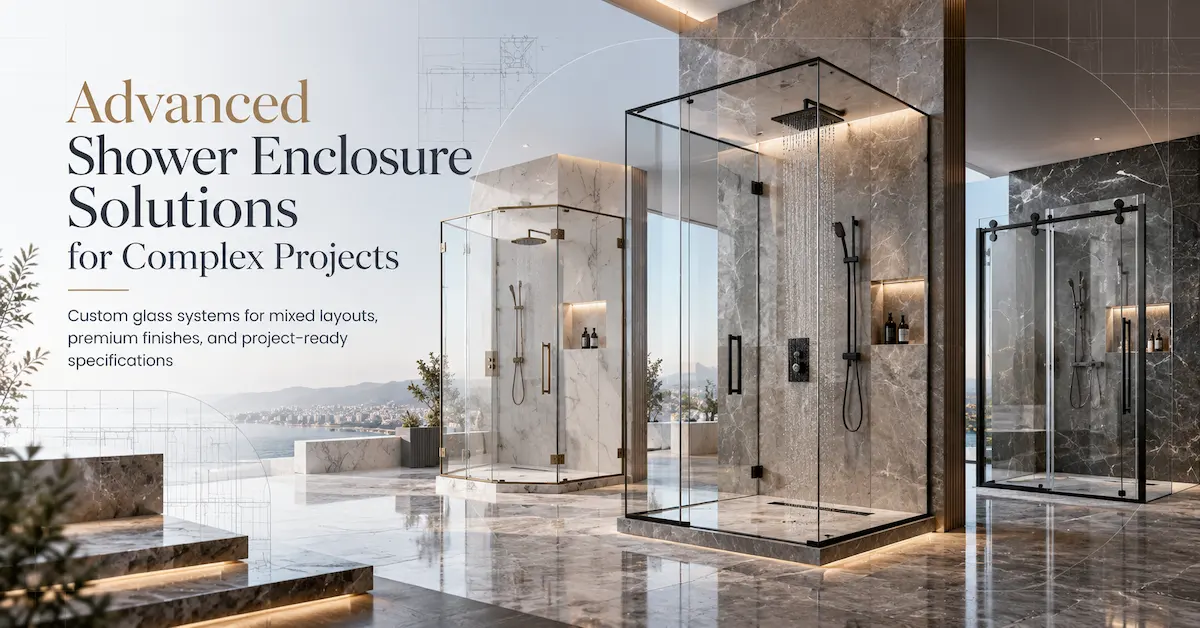
AOCLEAR's custom shower door manufacturing page provides a useful starting vocabulary: frameless, semi-frameless and framed construction; pivot, sliding and bi-fold opening mechanisms; clear, frosted, patterned and low-iron glass; and selected hardware and coating options. A buyer's custom shower door product development brief should turn that vocabulary into a specific configuration with an owner, revision and acceptance criteria.
Who Needs a Custom Shower Door Development Process?
The process is most valuable when the buyer expects more than one unit, a private-label collection, a project-specific fit, a differentiated finish, or a repeat order. A one-off residential replacement may only need a measured quotation. A brand launch, hotel program, apartment development, distributor range, or renovation package needs stronger control because a small design change can affect many rooms, cartons, installation teams, and replacement parts.
| Buyer | Typical development need | Evidence to request |
|---|---|---|
| Bathroom brand | Distinctive design, stable specification, private label and future variants | Approved drawings, sample, finish standard, component list, packaging and change history |
| Importer or distributor | A manageable range with clear installation and replacement information | Model matrix, carton data, spare references, instruction files and market documents |
| Hotel or property developer | Room-type standardization, phased delivery, maintenance and replacement control | Room schedule, opening survey, installation drawing, packing labels and inspection plan |
| Contractor or installer | Fit to actual wall, curb, threshold and service conditions | Site measurements, tolerances, handing, hardware details and installation sequence |
AOCLEAR identifies importers, distributors, retailers, e-commerce sellers, contractors, property developers and hospitality projects among the customer groups it serves. Its product pages also describe shower doors and enclosures for residential, hospitality and commercial bathrooms. Those published customer groups establish relevance; they do not prove that every proposed design is suitable for every market or installation condition.
Review Custom Shower Door Options
What Should Be Frozen Before Design Starts?
Do not begin detailed drawing work with only a reference image. First freeze the design inputs that determine the product boundary. A buyer can still leave some choices open, but each open choice should have an owner and a decision date. Otherwise, the sample becomes a moving target and the quotation cannot be compared fairly.
Define the use case and target market
State whether the door is for a private bathroom, apartment, hotel, gym, spa, senior living facility, commercial washroom, or another environment. Record the intended market and any project standards that the compliance team has identified. Use environment and market to set priorities: an apartment range may value a controlled cost and easy replacement, while a hotel program may need room-by-room handing, finish consistency and spare-part identification.
Define the opening and installation condition
Record the opening type, finished width and height, wall condition, curb or threshold, adjacent fixtures, door handing, swing clearance, drain direction and installation sequence. AOCLEAR's published measurement guide asks buyers to measure width at the top, middle and bottom and use the smallest measurement; it also calls for height, wall plumb, curb or threshold height and wall thickness. These fields are a baseline, not a substitute for a project drawing.
Define the product architecture
Choose the product object before discussing decoration. Is it an individual door for an existing alcove, a complete enclosure, or a walk-in screen? A door-only product has different support and sealing assumptions from a complete enclosure. The AOCLEAR shower doors and enclosures category separates shower doors, complete enclosures and walk-in screens, which is a useful distinction for custom shower door product development and for the product brief.
How Should Glass, Frames, and Hardware Be Selected?
Specify the shower door as a coordinated assembly. A glass thickness without a panel size, edge condition, hinge or roller reference, hole pattern, support method and seal arrangement is not a complete engineering instruction. The buyer should request the supplier's proposed component references and identify which items are standard, modified, or newly developed.
Glass selection
AOCLEAR's custom shower door page lists 6-10 mm tempered glass options for its frameless, semi-frameless and framed product descriptions. It also lists clear, frosted, patterned and low-iron appearances, with the same 6-10 mm range shown on those glass options. Use these published values as a starting point for the RFQ, then ask the supplier to confirm the selected thickness and appearance for the exact panel size, hole layout, mechanism, destination market and model.
Record the glass appearance by approved sample or reference, not only by a marketing name. Confirm edge polishing, corner treatment, hole location, cut-outs, labels, protective film and the permitted visual variation. If the buyer requires low-iron glass, privacy glass or a pattern, the sample approval should identify the face, orientation and cleaning expectations.
Frame and opening mechanism
Frame choice affects the visual language, support condition, adjustment method and water-management detail. AOCLEAR describes frameless, semi-frameless and framed approaches. Its page lists pivot, sliding and bi-fold opening mechanisms. Compare them against available clearance, user flow, panel weight, track or hinge support, cleaning access and replacement parts rather than treating one mechanism as universally better.
Hardware and seals
The official page describes corrosion-resistant stainless hardware, quick-release rollers, adjustable alignment, magnetic seals, bottom sweeps and easy-clean or nano-coating options. These are published product statements, not a complete bill of materials or universal performance guarantee. Ask for the exact hinge, roller, handle, profile, fastener, seal and coating reference. Record the finish using a physical sample or approved color reference.
| Assembly area | Minimum information | Approval evidence |
|---|---|---|
| Glass | Type, thickness, appearance, panel size, holes, cut-outs, edge and corner treatment | Approved drawing, glass sample or appearance standard, safety document where applicable |
| Structure | Frame or support, profiles, wall interfaces, stabilizers, threshold and adjustment range | Section detail, mounting method, finish sample and installation instruction |
| Motion | Pivot, hinge, sliding or bi-fold mechanism, handing, travel, clear entry and stops | Operation sample, hardware list, adjustment and replacement method |
| Water management | Seals, sweeps, gaps, threshold, wall profile, floor slope and spray direction | Assembly-specific test or demonstration method and installation assumptions |
| Identity | Model, revision, label, carton reference, spare references and approved brand treatment | Released specification, packaging artwork and change record |
What Is DFM in Custom Shower Door Product Development?
Design for manufacturing, or DFM, is the review that asks whether the proposed product can be fabricated, assembled, inspected, packed and installed consistently at the intended quantity. It should happen before the buyer treats a rendering as a final design. In custom shower door product development, a DFM review is especially important when the product uses non-standard glass holes, unusual angles, new profiles, special finishes, concealed hardware or a mixed set of components.
Questions for the glass process
- Are the panel dimensions, angles, holes and cut-outs compatible with the chosen glass process?
- Are edge, corner and hole requirements clear enough for the supplier to quote and inspect?
- Does the panel size, thickness and hardware load match the selected opening mechanism?
- Is the approved glass appearance available in the requested quantity and market scope?
- Which dimensions are critical to installation, and which are allowed to vary within a stated tolerance?
Questions for profiles, hardware and assembly
- Can the profile, hinge, roller, handle and seal be assembled without forcing the glass or masking a fit problem?
- What adjustment range is available for wall conditions, and what condition is outside that range?
- Can the selected finish be inspected consistently, and is there an approved reference sample?
- Can the component be identified and replaced after installation without dismantling unrelated parts?
- Does the packing method protect corners, edges, hardware finish and glass faces during phased delivery?
AOCLEAR's about page describes product development, mold development, glass processing, assembly, quality inspection, packaging and international sales as integrated manufacturing stages. That published process description supports a development conversation, but the buyer should still request a project-specific DFM review and identify what is approved, what is modified and what remains open.
How Should Dimensions and Tolerances Be Controlled?
Dimensions should be controlled from a defined datum, not from whichever edge is easiest to measure. In custom shower door product development, the product drawing should show finished opening assumptions, panel sizes, profile lengths, hole centers, hinge or roller locations, clear entry, threshold relationship and any adjustment allowance. The quotation should distinguish the finished room measurement from the fabricated component measurement.
Separate room tolerance from product tolerance
A wall that is out of plumb, a threshold that is not level, and a glass panel that is cut outside its drawing tolerance are different problems. A wall profile or adjustment feature may absorb a defined installation variation, but it cannot correct every dimensional error. Ask the supplier to state which installation variation is allowed, which dimensions are controlled at fabrication, and which field condition must be corrected by the installer.
Use a critical-to-quality register
For each critical dimension, record the nominal value, tolerance, datum, measurement tool, sampling plan and acceptance decision. Typical critical-to-quality items may include glass width and height, hole center, hinge or roller spacing, profile length, clear entry, door overlap, seal compression, threshold position and panel alignment. These are recommended control fields, not universal AOCLEAR specifications. The supplier must confirm the actual values for the design.
| Field | Example of a controlled entry | Question for the supplier |
|---|---|---|
| Datum | Finished sill, profile centerline or drawing reference edge | What reference is used for every related dimension? |
| Nominal and tolerance | Drawing value plus an agreed allowable range | Which tolerance is contractual, and which is only a design assumption? |
| Measurement method | Caliper, steel rule, height gauge, fixture, optical tool or CMM where suitable | What tool, resolution, calibration status and operator method apply? |
| Sampling | First article, defined batch sample or 100% check for a critical feature | When is the dimension checked and what happens after a failure? |
| Record | Inspection sheet linked to model, batch, drawing revision and disposition | Can the buyer review the record or receive a release summary? |
Do not insert a generic tolerance number into a purchase order simply because the project needs one. A tolerance must match the material, process, dimension, installation interface and inspection method. The official website does not publish a universal tolerance table for every custom shower door, so the correct commercial action is to request a drawing-specific tolerance schedule.
When Should a Buyer Request CMM or Other Metrology?
A coordinate measuring machine, or CMM, may be useful when the product has several related datums, tight positional relationships, irregular geometry, repeated holes, a complex frame, or a dispute that cannot be resolved reliably with a simple hand tool. In custom shower door product development, CMM is a measurement method, not proof of quality by itself. The result is meaningful only when the drawing, datum scheme, probe setup, calibration status, software report and acceptance tolerance are defined.
CMM questions for a development RFQ
- Which critical features require a coordinate report, and why can ordinary gauges not provide sufficient confidence?
- What datum reference frame will be used for glass holes, hinge locations, rollers, profiles or mounting points?
- Will the CMM inspect the glass, the metal assembly, a fixture, a first article, or a sampled production unit?
- What report will be provided: measured value, nominal value, tolerance, deviation, pass/fail and drawing revision?
- What alternative method is acceptable for features that are too large, reflective, flexible or difficult to fixture?
AOCLEAR's public pages describe precision trimming and finishing, glass processing, assembly, functional testing and final inspection, but they do not state that every custom shower door is measured by CMM. Therefore, a buyer should ask whether CMM, a custom fixture, optical measurement, gauges or another method is appropriate for the selected design. The answer should be recorded in the inspection plan rather than implied by the word precision.
Request a Product Development Review
How Should Prototype and Sample Approval Work?
A prototype should answer defined questions. It is not only a marketing sample. Before a supplier builds it, list the features that must be demonstrated and the people who approve them. In custom shower door product development, a sample can be visually attractive and still fail because the door handing is wrong, the glass holes do not match the hardware, the seal does not control the intended spray, or the carton cannot protect the finish.
Use staged approvals
- Brief approval: confirm application, target market, architecture, opening, product family, finish and option boundaries.
- Drawing approval: confirm datums, panel layout, critical dimensions, tolerances, hardware and installation assumptions.
- Component approval: approve glass appearance, profile finish, hardware, seals, handle and any coating against identified references.
- Functional sample: check opening, movement, alignment, adjustment, water direction, seals, cleaning access and serviceability.
- Production release: issue the final revision, inspection plan, packing specification, label artwork and approved change route.
For a private-label product, the approval record should also state which details are proprietary, which components can be substituted, and who must authorize a change. If a supplier proposes a different roller, glass source, finish or seal after approval, the change should be evaluated for fit, appearance, performance, compliance, packing and spare parts.
What Testing and Compliance Evidence Should Be Requested?
Testing should be tied to a risk and an acceptance rule. For a shower door, the custom shower door product development plan may include dimensional fit, opening and closing, hardware alignment, seal contact, water management, appearance, coating behavior, packaging protection and applicable safety-glazing documentation. The exact tests depend on the product, market, configuration and buyer's project requirements.
| Risk or decision | Evidence to request | Boundary to record |
|---|---|---|
| Glass safety | Applicable glass description, certificate or test document, thickness and scope | Exact glass, model, market, date and issuing body |
| Dimensional fit | Approved drawing, measurement report, inspection method and disposition | Revision, datum, units, tolerance and sample or batch identity |
| Water management | Defined spray or demonstration method, assembly condition and acceptance rule | Installation assumptions, seals, threshold and water direction |
| Surface and finish | Approved finish sample, visual criteria and coating or cleaning information | Viewing condition, reference sample, allowed variation and care method |
| Shipment | Packing specification, carton identification, protection method and receiving check | Package contents, delivery phase, damage evidence and claims process |
AOCLEAR's custom shower door page references ANSI Z97.1 certified tempered glass and presents safety, sealing and coating claims. Its custom enclosure page lists additional certification and standard names. These are company-published statements and must be matched to the exact product, component, configuration, market and certificate scope before they are used in a project submittal. Do not turn a page-level list into a blanket claim for every model.
For a serious order, ask for the document number, revision or issue date, issuing body, applicable model, market, test method and limitations. If the website does not provide those details, mark the item as pending confirmation rather than writing a number into the article or purchase order.
How Do Packaging and Spares Affect Product Development?
Packaging is part of the product release because the buyer receives a carton, not a drawing. In custom shower door product development, glass edges, corners, coated surfaces, hardware finish and small seals can be damaged or separated if the package is not designed around the approved assembly. A development file should show how the unit is protected, identified, counted and inspected when it reaches the warehouse or workface.
- Identify glass panels, profiles, hardware and fasteners by model or room reference.
- Separate fragile surfaces from metal contact points and protect edges and corners.
- List package contents, spare seals, fasteners, rollers, hinges and installation accessories where applicable.
- Define carton labels, revision, quantity, destination and room or unit reference for phased projects.
- Agree receiving photos, damage reporting, quarantine and replacement identification before shipment.
The official about page states that AOCLEAR integrates final inspection and export packaging into its manufacturing stages. The public pages do not publish one universal carton specification, packing test result, spare-part list or damage rate. Request these against the proposed product and delivery plan. This is more useful than describing packaging as simply export quality.
What Should a Custom Shower Door RFQ Include?
A good RFQ lets a manufacturer distinguish a real development project from a general price request. For custom shower door product development, send a concise brief and attach the information that controls the product. If some items are unknown, label them as open questions. An honest incomplete brief is easier to develop than a confident brief built on hidden assumptions.
| RFQ section | Buyer should provide | Supplier should return |
|---|---|---|
| Commercial brief | Application, target market, quantity, launch date, price position and sales channel | Feasibility comments, assumptions, sample conditions, MOQ and timing basis |
| Technical brief | Opening, room drawings, glass, frame, mechanism, finish, seals and options | DFM review, component proposal, drawing and open-item list |
| Validation | Required standards, tests, dimensional controls, CMM or other metrology request | Inspection plan, sample method, report format and document scope |
| Brand and packing | Logo, label, carton, instruction, spare and private-label requirements | Artwork limits, package proposal, contents, samples and change impact |
| Approval route | Decision owners, review dates, acceptance criteria and change authority | Milestones, responsibilities, exclusions and production-release conditions |
When requesting a proposal from AOCLEAR, you can use the custom shower door page to select the initial vocabulary, then ask the team to translate it into a model-specific drawing, component schedule and quotation. For a broader assembly that includes panels and multiple shower elements, compare the custom enclosure scope before treating a door-only design as a complete enclosure.
Suggested inquiry wording: “We are developing a custom shower door for a [project, brand or distribution range] in [market]. Please review the attached opening and concept, propose a manufacturable glass, frame and hardware configuration, and identify the drawing revision, critical dimensions, tolerances, inspection method, applicable documents, sample stages, packing scope, MOQ and lead-time trigger. Please separate standard, modified and newly developed components, list exclusions, and identify what must be approved before production release.”
How Can Buyers Control Changes After Sample Approval?
Most repeat-order problems are not caused by the first design alone. They arise when a glass source, roller, profile, finish, seal, carton or installation assumption changes without a linked review. In custom shower door product development, a simple change-control record should state what changed, why it changed, who approved it, which documents are affected, and whether a new sample or validation step is required.
Classify changes by risk
- Low risk: wording, internal label or artwork change with no effect on fit, safety, function or package contents.
- Moderate risk: finish, handle, seal, carton insert or supplier change that may affect appearance, installation or spare parts.
- High risk: glass thickness, panel geometry, holes, hinges, rollers, profiles, water boundary, electrical module or market compliance document.
A high-risk change should trigger a drawing review and a decision about sample, dimensional inspection, functional test, water demonstration, certification review and packaging revalidation. The goal is not to prevent every improvement. The goal is to stop a change from entering a repeat order without the buyer understanding its effect.
Frequently Asked Questions
How long does custom shower door product development take?
The reviewed AOCLEAR pages do not publish one universal development or production lead time. Timing depends on the design, glass and hardware combination, sample stages, tooling or profile work, approval speed, quantity, packing and destination. Ask the supplier to state the milestone that starts each timing estimate, such as brief confirmation, drawing approval, sample approval or production release.
Can the buyer request a custom size?
AOCLEAR's product category states that its manufacturing scope supports custom glass dimensions and panel layouts, while its custom shower door page provides a measurement guide. The exact size limit, tolerance, glass thickness and mechanism compatibility must be confirmed for the proposed configuration rather than assumed from a general customization statement.
Does a 6-10 mm glass range apply to every custom shower door?
No. The official custom shower door page lists 6-10 mm tempered glass options for its published product descriptions. That range is not a promise that every thickness is available for every panel size, hole pattern, frame, hinge, roller, market or project. Put the selected thickness on the approved drawing and quotation.
Should every development project require CMM inspection?
No. CMM is useful when the geometry, datum relationships or positional accuracy justify coordinate measurement. A simple door may be controlled with suitable gauges, fixtures or other methods. Ask the supplier which method is appropriate for each critical feature, and require the method, calibration, report and acceptance tolerance to be defined.
What is the difference between a prototype and a production sample?
A prototype may explore geometry, appearance or function and can contain temporary components. A production sample should represent the released materials, hardware, finish, labels and packing that will be used for the order. Confirm which type is being approved, because approving a concept prototype is not the same as releasing a production configuration.
Does AOCLEAR publish MOQ, tolerance and lead time for custom shower doors?
The reviewed official pages do not publish one universal MOQ, fixed tolerance schedule or lead time for every custom shower door. Request these items for the proposed model, quantity, market, sample requirement and delivery phase. A supplier's answer should identify assumptions and the approval event that controls timing.
Which documents should be approved before mass production?
At minimum, align the final product brief, drawing, component schedule, finish or glass references, inspection plan, applicable certificate or test scope, packing specification, labels, installation instructions and change-control owner. The exact document pack depends on the project and market. Keep the released revision attached to the purchase order or approved supplier record.
Conclusion
Custom shower door product development becomes commercially reliable when the buyer treats the door as a controlled assembly rather than a picture. Start with the application and opening, freeze the product architecture, define glass and hardware, review DFM, approve drawings and samples, then validate critical dimensions, operation, water management, appearance, documents and packing.
For an RFQ that can support a real decision, send the target market, opening data, room drawings, product concept, glass, frame, mechanism, finish, seals, quantity, validation requirements and approval route. Ask the manufacturer to separate standard, modified and newly developed parts, state drawing-specific tolerances, explain the measurement method including whether CMM is appropriate, and identify every condition that must be approved before production release.