
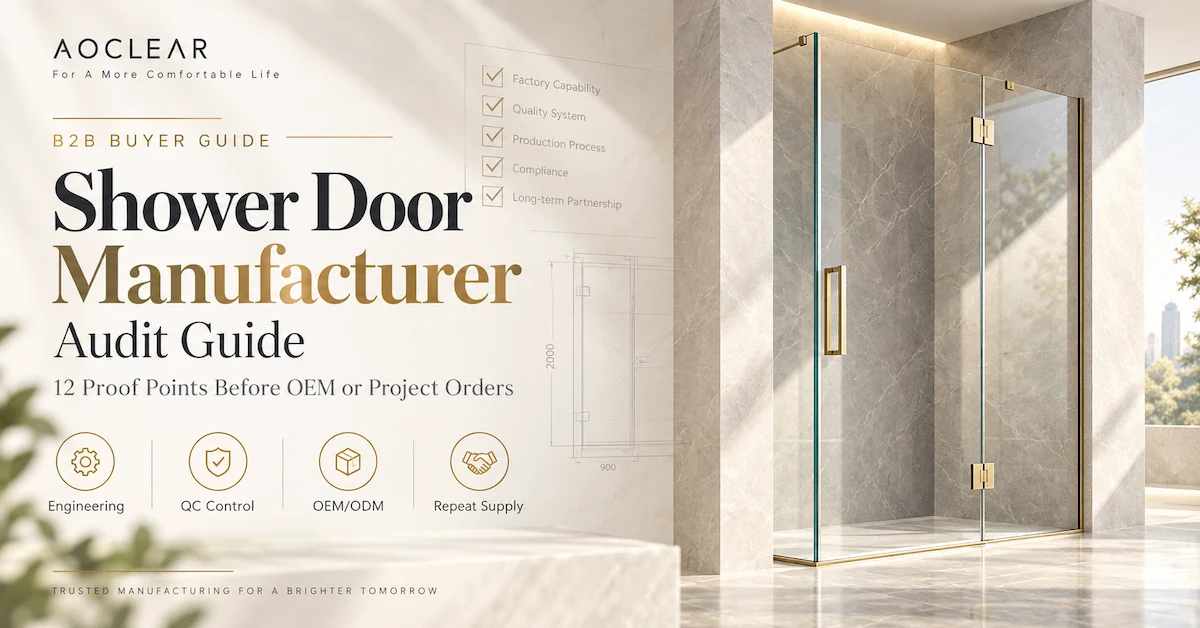
How Should B2B Buyers Evaluate a Shower Door Manufacturer?
A good-looking shower door sample proves that one product can be made.
It does not prove that a manufacturer can repeatedly deliver the same glass dimensions, hardware finish, opening performance, seal arrangement, packaging, and documentation across an OEM program or multi-room project.
For B2B buyers, selecting a shower door manufacturer is therefore a process-verification decision, not simply a catalog or price comparison.
Before approving a supplier, verify whether the manufacturer can control the complete path from technical requirements to repeat production:
Requirement → Drawing → Material/Component Definition → Sample → Approval → Production → Inspection → Packaging → Shipment → Repeat Order
AOCLEAR's current shower door and enclosure range includes shower doors, complete enclosures, and walk-in screens for residential, hospitality, commercial, distributor, contractor, and OEM/ODM applications.
The following 12-point audit framework helps buyers evaluate whether a potential manufacturing partner can support more than a one-time order.
1. Verify What the Manufacturer Actually Controls
Start by asking a basic question:
Which parts of the shower door manufacturing process are actually controlled by the supplier?
A professional shower door manufacturer should be able to explain its role in areas such as:
-
Product engineering
-
Glass processing
-
Profile preparation
-
Hardware selection
-
Assembly
-
Dimensional inspection
-
Functional inspection
-
Packaging
-
Export preparation
The objective is not to demand that every screw, seal, and fitting be produced inside one building.
What matters is whether the manufacturer controls the specification, approves the components, manages incoming quality, and takes responsibility for the finished system.
AOCLEAR states that its manufacturing operation integrates product development, glass processing, aluminum and stainless-steel fabrication, assembly, functional testing, final inspection, and export packaging. Buyers can review the wider AOCLEAR manufacturing background when conducting supplier verification.
2. Check Whether Engineering Starts Before the Quotation
A quotation that arrives too quickly can sometimes be less useful than one that asks the right technical questions first.
A shower door manufacturer should understand the intended installation before finalizing a custom or project quotation.
Important inputs can include:
-
Finished opening dimensions
-
Wall condition
-
Shower base or curb
-
Door opening direction
-
Fixed-panel position
-
Glass configuration
-
Hardware finish
-
Water direction
-
Installation tolerance
-
Destination market
-
Quantity
-
Packaging requirements
For custom shower doors, AOCLEAR's measurement process asks buyers to check opening width at multiple points, opening height, wall plumb, curb or threshold height, and wall thickness.
That illustrates an important purchasing principle:
A manufacturer should identify missing installation information before glass enters production—not after products arrive on site.
Buyers developing non-standard products can review the custom shower door manufacturing options.
3. Ask How the Product Configuration Is Defined
The term “shower door” covers many different systems.
A manufacturer may produce:
-
Framed doors
-
Semi-frameless doors
-
Frameless doors
-
Pivot doors
-
Hinged doors
-
Sliding doors
-
Bi-fold doors
-
Fixed glass screens
-
Multi-panel systems
Each configuration creates different requirements for glass, support, movement, sealing, wall fixing, and installation.
For example, a frameless product relies more heavily on the relationship between glass, hinges, brackets, wall fixing, and dimensional accuracy because there is less continuous framing around the glass.
A sliding system depends more strongly on rollers, tracks, guides, anti-jump components, and alignment.
A manufacturer should therefore define the product as a complete system, not simply as “8 mm glass with black hardware.”
A Better Specification Structure
| Area | What the Buyer Should Define |
|---|---|
| Door structure | Framed, semi-frameless, frameless |
| Opening | Hinged, pivot, sliding, folding |
| Glass | Type, thickness, finish |
| Profiles | Material, geometry, finish |
| Hardware | Hinges, rollers, brackets, handles |
| Seals | Magnetic, vertical, bottom |
| Opening size | Finished installation dimensions |
| Fixing | Wall and threshold conditions |
| Finish | Chrome, black, brushed, or approved option |
| Packaging | Export, retail, private label, project identification |
If two suppliers are quoting different systems, their prices should not be treated as directly comparable.
4. Audit Glass Processing, Not Just Glass Thickness
Glass thickness is easy to put on a quotation.
Manufacturing accuracy is harder to demonstrate.
Buyers should ask how the manufacturer controls:
-
Glass dimensions
-
Edge processing
-
Hole locations
-
Notches
-
Cut-outs
-
Surface appearance
-
Tempering requirements
-
Panel identification
A small error in a hole position may create a large problem during installation because the hinge or bracket cannot simply be moved after the glass has been processed.
The same applies to frameless doors where hardware positions directly influence alignment.
AOCLEAR's shower door product information describes tempered safety glass and multiple glass configurations, while its customization page currently lists clear, frosted, patterned, and low-iron glass options with different project uses.
For purchasing purposes, the important step is to confirm which glass specification applies to your exact configuration before sample approval.
5. Trace the Hardware, Profiles, and Seals as Controlled Components
Shower door performance is rarely determined by the glass alone.
Components such as:
-
Hinges
-
Rollers
-
Tracks
-
Wall profiles
-
Handles
-
Brackets
-
Fasteners
-
Magnetic seals
-
Bottom sweeps
-
Vertical seals
all affect how the finished product performs.
During a factory audit, buyers should ask:
Can these components change between the sample and mass production?
If the answer is yes, ask how substitutions are approved.
An uncontrolled hardware change can affect:
-
Hole positions
-
Door weight support
-
Opening movement
-
Closing alignment
-
Finish consistency
-
Spare-part compatibility
-
Installation instructions
For OEM and repeat-order programs, the approved component specification should become part of the controlled product definition.
6. Require a Drawing and Revision-Control Process
One of the strongest signs of an organized shower door manufacturer is not a large showroom.
It is controlled technical documentation.
For custom, private-label, and project orders, buyers should be able to identify which drawing or specification revision controls production.
A useful approval record may include:
-
Buyer product code
-
Manufacturer reference
-
Drawing revision
-
Overall dimensions
-
Glass specification
-
Hole and cut-out positions
-
Frame/profile configuration
-
Hardware references
-
Handle selection
-
Finish
-
Seal arrangement
-
Branding
-
Packaging
-
Approval date
If a design changes, the new revision should be clearly distinguished from the previous version.
This reduces a common sourcing risk: production teams manufacturing from an outdated drawing while purchasing teams believe a newer version has already been approved.
7. Connect the Approved Sample to Mass Production
A sample is valuable only when it becomes a production reference.
Before approving mass production, buyers should clarify which elements of the sample are being frozen.
Examples include:
-
Dimensions
-
Glass appearance
-
Hardware
-
Finish
-
Door movement
-
Closing position
-
Handle
-
Profiles
-
Seals
-
Logo
-
Labels
-
Carton
-
Accessories
A photograph alone is not enough.
The sample should be connected to drawings, specifications, component references, and inspection requirements wherever practical.
This becomes particularly important for:
-
Hotel projects
-
Apartment developments
-
Distributor programs
-
Private-label brands
-
Multi-market product collections
AOCLEAR discusses repeatability and specification control in its guide to high-consistency shower door supply.
8. Ask What Is Inspected During Production and Before Shipment
Almost every supplier says it has QC.
The useful question is:
What exactly is checked for my product?
A practical shower door inspection plan may cover several stages.
Glass Checks
Possible checkpoints include:
-
Dimensions
-
Hole locations
-
Cut-outs
-
Edge condition
-
Surface appearance
-
Correct glass configuration
Profile and Hardware Checks
Inspect:
-
Correct components
-
Finish consistency
-
Dimensions
-
Fastener compatibility
-
Assembly interfaces
Functional Checks
Depending on the system, review:
-
Door movement
-
Roller operation
-
Hinge operation
-
Closing position
-
Handle security
-
Panel alignment
-
Seal contact
Final Appearance Checks
For multi-unit projects and retail programs, visible consistency also matters.
A group of products installed side by side should not show obvious unexplained differences in:
-
Finish
-
profile appearance
-
hardware appearance
-
glass treatment
-
component position
AOCLEAR's current shower product page states that its shower operation includes glass processing, hardware assembly, dimensional checks, and water-tightness related inspection. Buyers should still define which checks apply to their specific order.
9. Evaluate Water Management as a System
The previous AOCLEAR article on shower door manufacturers already discusses waterproof performance in detail, so buyers do not need another generic explanation of “good seals prevent leaks.”
The more useful factory-audit question is:
Does the manufacturer evaluate water management at system level?
Water containment can depend on the relationship between:
-
Door overlap
-
Glass position
-
Bottom sweep
-
Magnetic seal
-
Vertical seal
-
Threshold
-
Shower base
-
Wall condition
-
Opening direction
-
Shower spray direction
-
Installation accuracy
This means a seal cannot be evaluated independently from the rest of the enclosure.
For project orders, clarify what the factory can control and which performance factors depend on site installation.
This distinction prevents unrealistic expectations and makes responsibility clearer before shipment.
10. Inspect Packaging Before Treating the Quote as Final
Packaging is often discussed too late.
For glass products, that is a mistake.
A shower door may pass factory inspection but still generate commercial losses if packaging is not suitable for:
-
International shipping
-
Container handling
-
Warehouse movement
-
Dealer distribution
-
Construction-site handling
Before confirming the order, review:
-
Glass protection
-
Corner protection
-
Hardware separation
-
Component identification
-
Model labeling
-
Carton strength
-
Installation-document placement
-
Private-label artwork
-
Barcode requirements
-
Project-room or model identification where needed
Packaging should also help installers understand which glass and hardware belong together.
For hotels or developments with several room types, packaging identification can reduce sorting mistakes after delivery.
11. Test OEM/ODM Capability With a Real Change Request
Many companies advertise OEM/ODM.
That does not show how well customization is managed.
A better test is to ask the manufacturer to evaluate a specific change, such as:
-
Different opening width
-
Alternative glass
-
New hardware finish
-
Changed handle
-
Modified profile
-
Private-label logo
-
Custom carton
-
Market-specific documentation
Then observe the process.
Does the supplier immediately say “yes” to everything?
Or does the technical team explain:
-
What can be changed
-
What cannot
-
What requires engineering review
-
Whether new drawings are needed
-
Whether the change affects hardware
-
Whether a sample is recommended
-
Whether packaging needs revision
-
Whether cost or timing changes
A manufacturer that understands the consequences of customization is usually more useful than one that simply promises unlimited customization.
AOCLEAR's custom shower door service currently covers frame types, opening mechanisms, glass options, hardware systems, dimensions, finishes, and related OEM configurations.
12. Audit Repeat-Order and Change-Control Readiness
The first order is only one part of the supplier relationship.
For distributors, brands, hotel groups, and property developers, the more important question may be:
Can the same approved product still be reproduced on the next order?
Ask how the manufacturer handles:
-
Product revision records
-
Hardware substitutions
-
Finish changes
-
Component discontinuation
-
Packaging updates
-
Repeat-order references
-
Replacement parts
-
Buyer approval for changes
Without change control, a repeat order may arrive looking similar while containing components that are no longer compatible with earlier inventory.
That creates problems for:
-
Installation
-
Warranty
-
Dealer support
-
Replacement parts
-
Brand consistency
A reliable manufacturer should communicate material product changes before production rather than allowing buyers to discover them after delivery.
Shower Door Manufacturer Audit Scorecard
The following scorecard gives purchasing teams a simple structure for supplier evaluation.
| Audit Area | Evidence to Request | Main Risk if Missing |
|---|---|---|
| Manufacturing scope | Process explanation / factory evidence | Unclear production responsibility |
| Engineering | Drawings and technical review | Wrong configuration |
| Glass processing | Dimension and processing controls | Fit and hardware problems |
| Components | Approved hardware/profile/seal references | Uncontrolled substitutions |
| Sample approval | Recorded approved specification | Sample-production mismatch |
| Revision control | Drawing/version records | Production from old information |
| QC | Model-specific inspection points | Inconsistent shipments |
| Water management | System-level review | Leakage disputes |
| OEM/ODM | Controlled customization process | Development errors |
| Packaging | Packaging specification | Transit damage |
| Compliance | Product/market-specific documents | Import or project risk |
| Repeat orders | Change and spare-part control | Future incompatibility |
The strongest supplier is not necessarily the company with the longest checklist.
It is the company that can provide clear evidence for the controls that matter to your specific product.
Manufacturer, Assembler, or Trading Supplier: Does It Matter?
“Factory direct” is often treated as automatically better.
That is too simple.
Different procurement models can be appropriate for different buyers.
| Procurement Need | Direct Manufacturer | Trading / Sourcing Supplier |
|---|---|---|
| Technical product development | Strong fit when factory capability matches | Depends on manufacturing partner |
| Custom glass/hardware | Direct technical communication | Often requires coordination |
| OEM/ODM program | Strong when engineering is controlled | Depends on upstream factory |
| Mixed unrelated products | Usually narrower range | Can offer broader consolidation |
| Small mixed orders | May be less flexible | Can sometimes be easier |
| Repeat shower door program | Strong when specifications are controlled | Depends on supplier continuity |
| Factory process visibility | More direct | Often less direct |
The purchasing objective should not be “factory at any cost.”
It should be:
Choose the supply structure that gives you the right level of technical control, commercial flexibility, and long-term accountability.
What Should Different Buyers Audit Most Carefully?
Different buyers face different failure costs.
Importers and Wholesalers
Prioritize:
-
Compliance documentation
-
Packaging
-
Batch consistency
-
Repeat-order control
-
Spare parts
-
Export execution
Private-Label Bathroom Brands
Prioritize:
-
Product development
-
Revision control
-
Appearance consistency
-
Branding
-
Packaging
-
Component continuity
Hotel and Resort Projects
Prioritize:
-
Room-type standardization
-
Finish consistency
-
Installation readiness
-
Replacement parts
-
Phased delivery
-
Maintenance support
Property Developers and Contractors
Prioritize:
-
Finished opening dimensions
-
Wall tolerance
-
Installation method
-
Drawings
-
Site coordination
-
Delivery sequence
Architects and Specifiers
Prioritize:
-
Glass and material definition
-
Visible finishes
-
Dimensions
-
Installation interfaces
-
Documentation
-
Compliance requirements
A manufacturer should be able to adapt its technical conversation to the buyer's actual risk—not give every customer the same sales presentation.
Why the Lowest Shower Door Price Can Be the Most Expensive Option
A low unit price is easy to compare.
Hidden costs are not.
A purchasing team should consider the total effect of:
-
Broken glass
-
Incorrect dimensions
-
Installation rework
-
Missing hardware
-
Finish variation
-
Packaging damage
-
Replacement shipments
-
Dealer complaints
-
Warranty handling
-
Project delay
-
Incompatible repeat orders
For example, a small saving per door may have little value if installation crews need additional site adjustment across hundreds of bathrooms.
The better commercial question is:
Which manufacturer gives us the most predictable installed and delivered result for this specification?
That shifts the purchasing decision from unit cost to total procurement risk.
What Should You Send a Shower Door Manufacturer for an Accurate RFQ?
A structured RFQ makes supplier comparison much easier.
Include:
-
Buyer type and project/application
-
Destination market
-
Estimated quantity
-
Shower door structure
-
Opening mechanism
-
Finished opening dimensions
-
Glass requirement
-
Hardware requirement
-
Profile requirement
-
Finish
-
Seal requirements
-
Branding
-
Packaging
-
Required compliance documents
-
Sample requirement
-
Expected delivery schedule
For custom installations, drawings or dimension sketches can significantly reduce quotation ambiguity.
Instead of sending:
“Please quote your best shower door.”
send something closer to:
“We are sourcing frameless shower doors for a multi-unit residential program. Please review the attached finished opening dimensions, required finish, quantity, packaging, destination market, and installation configuration before quotation.”
The second inquiry gives the manufacturer information that can actually be engineered and priced.
When Should You Reject a Shower Door Manufacturer?
Consider the risk carefully if a supplier:
-
Cannot explain who controls manufacturing
-
Avoids technical questions
-
Provides no controlled drawing for custom products
-
Cannot define glass or hardware specifications
-
Frequently substitutes components without approval
-
Treats the sample as unrelated to production
-
Cannot explain its inspection process
-
Gives unclear answers about certifications
-
Refuses to discuss packaging
-
Has no process for repeat-order changes
-
Promises every customization without technical review
One weak answer does not automatically disqualify a factory.
But several weak answers in areas that affect your project should be treated as a commercial warning.
Where Does AOCLEAR Fit in This Evaluation Framework?
AOCLEAR describes itself as a sanitary ware manufacturer founded in 2005, with business roots dating back to 2002.
Its published manufacturing information includes:
-
Product development
-
Glass processing
-
Aluminum and stainless-steel fabrication
-
Assembly
-
Functional testing
-
Final inspection
-
Export packaging
Its shower door range covers hinged, pivot, sliding, folding, framed, semi-frameless, frameless, enclosure, and walk-in configurations depending on the selected product solution.
For OEM/ODM buyers, the company also publishes customization options involving dimensions, glass, frame type, opening mechanisms, hardware, finishes, seals, branding, and packaging.
These capabilities make AOCLEAR relevant to distributors, bathroom brands, developers, contractors, hotels, and other B2B buyers evaluating a shower door manufacturing partner.
However, no buyer should select a manufacturer based on a company description alone.
Use the same audit process for AOCLEAR that you would use for any potential supplier: define your exact product, market, quantity, compliance requirements, packaging, and expected delivery conditions, then verify the relevant capability for that order.
Frequently Asked Questions
What should I look for in a shower door manufacturer?
Look beyond the catalog. Verify engineering capability, glass processing control, component management, drawing revisions, sample approval, QC, packaging, OEM/ODM execution, compliance support, and repeat-order control.
How can I verify whether a shower door manufacturer is reliable?
Request evidence tied to your actual product: drawings, sample specifications, component definitions, inspection procedures, packaging details, and explanations of how repeat orders and engineering changes are controlled.
Is a direct shower door factory always better than a supplier?
No. A direct manufacturer can provide stronger production visibility and technical communication when its capability matches your product. A sourcing supplier may be more practical for small mixed-category orders. Choose based on the procurement model.
What should be approved before mass production?
Approve the relevant drawing, glass specification, dimensions, hardware, profiles, seals, finish, branding, packaging, accessories, and inspection expectations. The exact list depends on the product.
Why is revision control important for custom shower doors?
Glass processing and hardware positions are difficult to correct after production. A controlled drawing revision helps prevent the factory from manufacturing from outdated dimensions or configurations.
How should shower door quality be inspected?
Inspection can cover glass dimensions and appearance, hole positions, edge condition, profiles, hardware, finish, assembly, door movement, alignment, seals, accessory completeness, and packaging. Agree the applicable checks before production.
Can a shower door manufacturer provide private-label products?
Manufacturers with OEM/ODM capability may support custom dimensions, finishes, glass options, hardware, logos, packaging, and other changes. The exact scope should be confirmed for the selected product.
What information affects shower door manufacturing cost?
Cost can be affected by glass, dimensions, frame structure, opening mechanism, profiles, hardware, finish, customization, order quantity, packaging, testing, and logistics requirements.
Should I request a shower door sample before a bulk order?
For custom, private-label, or project-specific products, a sample or pre-production approval can help confirm important details before mass production. The approved sample should be linked to documented specifications.
How do I request a quotation from AOCLEAR?
Prepare your application, quantity, destination market, dimensions or drawings, door configuration, glass preference, finish, OEM requirements, packaging, compliance needs, and target delivery schedule. Then submit the information through the AOCLEAR contact page.
Conclusion
Choosing a shower door manufacturer should be based on verifiable process control—not a catalog image, one successful sample, or the lowest quoted unit price. B2B buyers should confirm engineering, glass and component control, sample-to-production consistency, QC, packaging, customization, compliance, and repeat-order management before committing to a commercial program.
If you are evaluating a manufacturer for an OEM, private-label, hotel, residential, or commercial shower door program, review AOCLEAR's custom shower door manufacturing capabilities and contact AOCLEAR with your drawings, quantity, destination market, specifications, and packaging requirements for project-specific evaluation.