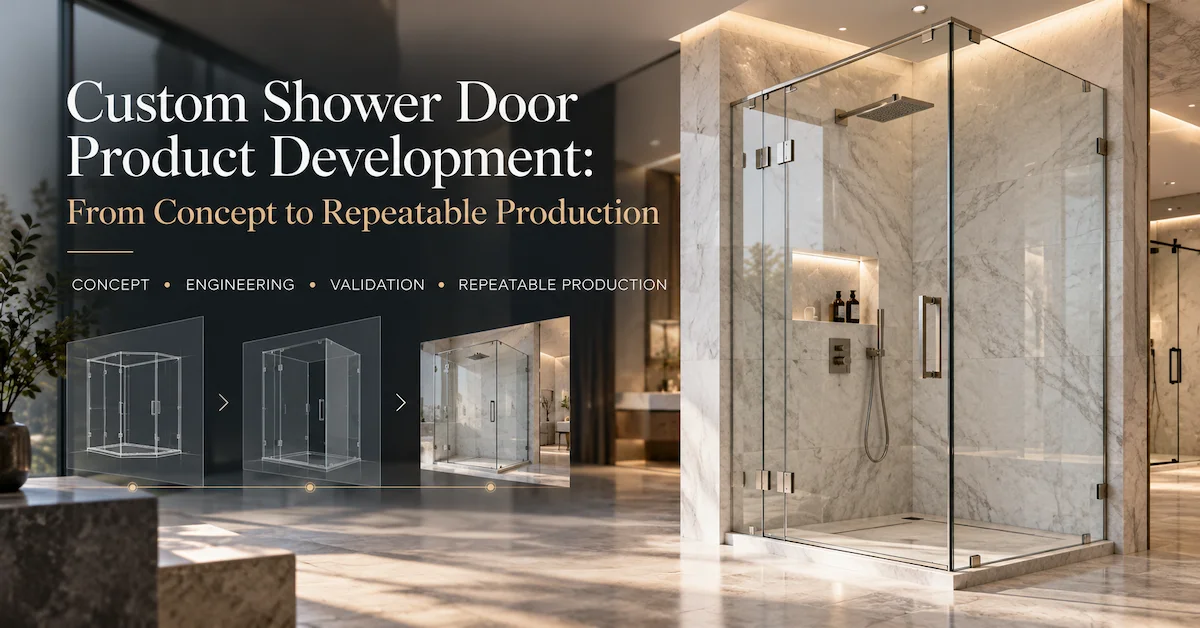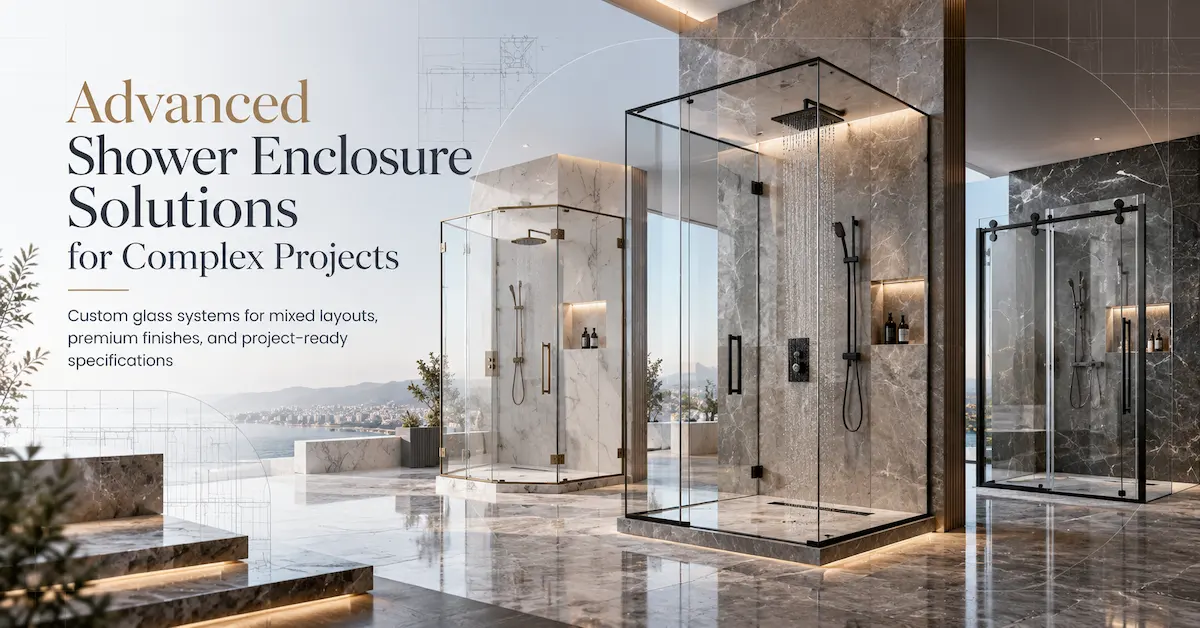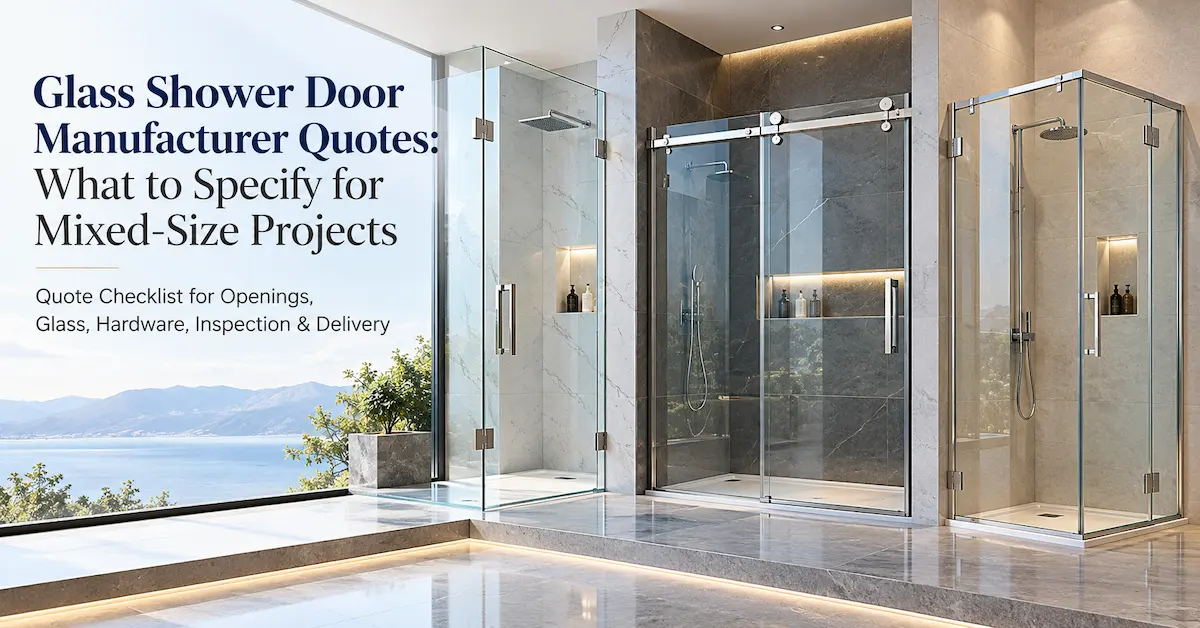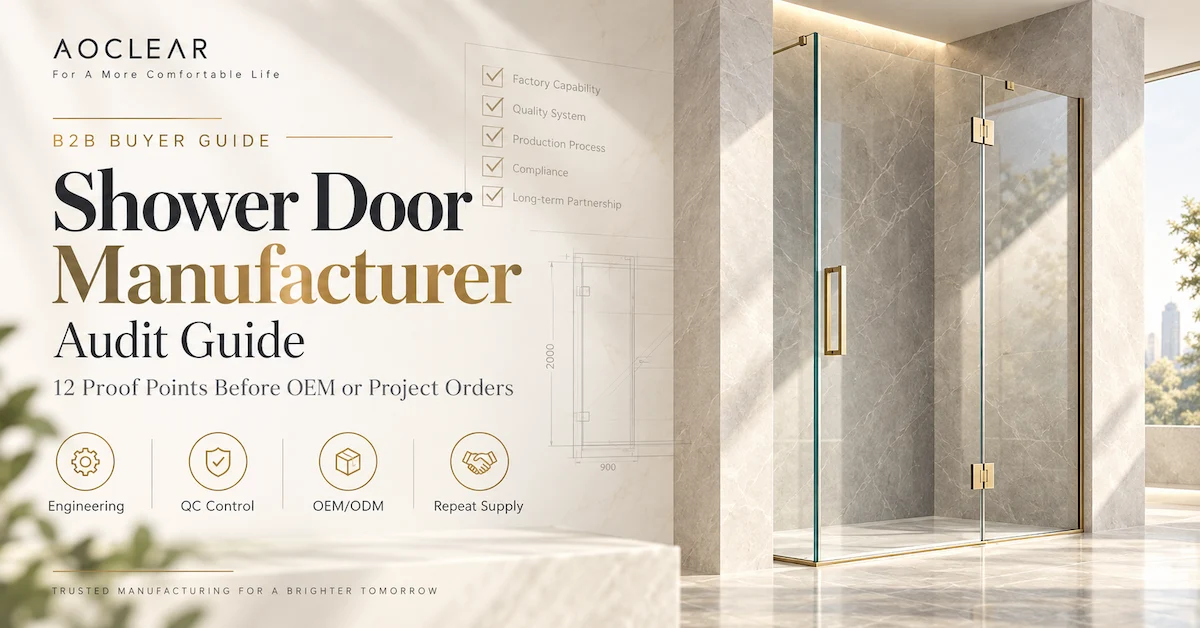
What Is an OEM Shower Enclosure Branding Service?
An OEM shower enclosure branding service turns a supplier's enclosure platform into a private-label product line that carries your brand identity, approved specification, packaging and repeat-order controls. The service should cover more than printing a logo. It should connect the enclosure shape, glass, hardware, seals, finish, accessories, installation documents, carton artwork, labels, inspection plan and change-control rules so that the product buyers see in a showroom can be reproduced in the next shipment.
This guide is for bathroom brands, importers, distributors, e-commerce sellers, hospitality procurement teams, contractors and property developers who want to launch or refresh a branded shower enclosure collection. The search intent is commercial investigation and RFQ preparation: what to define, what a manufacturer should deliver, which evidence to request, and how to protect brand consistency after the first approved sample.
AOCLEAR's official pages describe a China-based sanitary ware manufacturer in Jiaxing, Zhejiang, with product and mold development, glass processing, assembly, inspection, packaging and international sales in its integrated manufacturing scope. The same pages describe OEM and ODM customization for dimensions, colors, surface finishes, functions, branding and packaging. Those are company-published capabilities; the exact glass thickness, hardware set, certification scope, MOQ, lead-time trigger and packaging terms still need to be confirmed for the product revision in your quotation.
- Brand definition: translate the visual and commercial promise into an approved product brief.
- Engineering definition: select an enclosure architecture that can be produced, installed and inspected consistently.
- Brand delivery: control the physical product, packaging, documentation and customer handoff as one collection.
- Repeatability: release drawings, samples, inspection points and change rules before a second order is placed.
Review Custom Shower Enclosure Options
Who Benefits from a Branded Shower Enclosure Program?
A branded enclosure program makes sense when the buyer needs a recognizable collection rather than a one-off replacement. The buyer may be building a new bathroom brand, replacing a fragmented supplier base, standardizing hotel rooms, creating a distributor range or adding a higher-margin private-label option to an existing catalog. In each case, the commercial risk is the same: a product can look correct in a product image but fail when the next batch uses a different finish, seal, carton, hinge or installation assumption.
| Buyer | Typical branding task | Evidence to request |
|---|---|---|
| Bathroom brand | Build a coherent collection with a signature finish, handle language and packaging system | Approved sample, finish reference, component schedule, artwork proof and change log |
| Importer or distributor | Create a differentiated range without managing every process in-house | SKU matrix, carton dimensions, spare-parts list, inspection photos and shipment assumptions |
| E-commerce seller | Launch a small collection with clear installation content and low return risk | Dimension drawings, opening requirements, product photos, manuals and packaging protection |
| Hotel or developer | Standardize bathrooms across rooms, buildings or delivery phases | Room schedule, approved finish, installation tolerance, spare-unit plan and inspection records |
Branding Service vs. White-Label Stock
White-label stock usually means an existing product receives a new logo or carton. That can be appropriate when speed and low development effort matter more than differentiation. OEM branding is a broader process: the buyer controls the product brief, approved components, visual language, documents and release criteria. The supplier may start from an existing platform, but the final configuration is treated as a defined buyer-owned SKU or collection.
| Level | What changes | Best fit | Main risk |
|---|---|---|---|
| Stock rebrand | Logo, label and carton artwork | Fast catalog launch or test order | Weak differentiation and limited control of components |
| Configured OEM | Finish, glass appearance, handle, hardware, seals, dimensions and documents | Distributor collection, private label or hotel standard | Uncontrolled substitutions can break repeatability |
| Developed OEM/ODM | New geometry, tooling, interfaces, option package and brand system | Distinctive collection or project-specific architecture | More samples, approvals, tooling questions and validation work |
The correct choice is the lowest level that gives your brand the required market position, fit, installation performance and repeat-order control. Ask the supplier to state which parts are standard, modified or newly developed. This makes the quotation easier to compare.
Start with a Brand-Ready Product Brief
A clear brief is the first deliverable in an OEM shower enclosure branding service. It gives the manufacturer a decision framework before anyone spends time on detailed drawings. The brief should be short enough for a sales and engineering team to read in one sitting, but specific enough to expose the commercial and technical constraints.
Define the brand promise
Write the promise as a product behavior, not an adjective. "Premium" is not an acceptance criterion. "A quiet, easy-clean enclosure for compact urban bathrooms with a warm metal finish and simple replacement parts" is specific enough to guide configuration choices. The promise should identify the user, room, price position, visual character and service expectation.
Define the collection architecture
Decide whether the collection will contain one core enclosure, several width ranges, a hinged and sliding version, or a family of square, neo-angle and walk-in configurations. A consistent collection normally shares a visual anchor such as a handle profile, edge treatment, hardware finish or packaging hierarchy. It does not require every SKU to use identical glass or mechanism.
Define the target market and installation context
US, European, Middle Eastern and other markets can differ in preferred opening sizes, hardware finishes, documentation, safety-glazing evidence and installer expectations. State the market, application and installation condition at the start. For projects, include wall construction, curb or threshold, room schedule, delivery phase and who owns site measurement.
| Brief section | Questions to answer | Output |
|---|---|---|
| Commercial role | Who buys it, where is it sold, and what problem does the brand solve? | Buyer profile and positioning statement |
| Collection logic | Which shapes, mechanisms, sizes and finishes belong together? | SKU or configuration matrix |
| Technical scope | What glass, hardware, seals, profiles, options and interfaces are required? | Preliminary product specification |
| Brand system | Where should the logo, colors, labels, manuals and carton graphics appear? | Brand application and artwork brief |
| Launch controls | What sample, inspection, documentation and approval gates are mandatory? | Approval and evidence checklist |
Choose the Enclosure Architecture Before Adding Brand Details
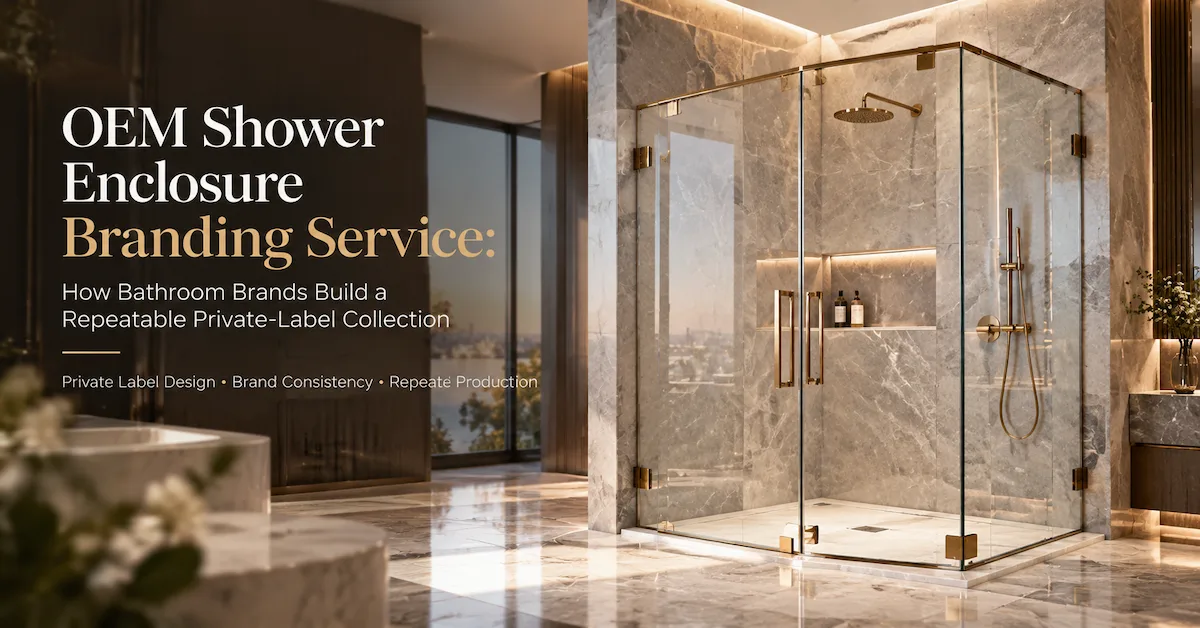
Brand identity is easier to protect when the underlying architecture is suitable for the room and market. A logo cannot compensate for a mechanism that is difficult to install, a finish that is hard to source consistently or a water boundary that was never defined. AOCLEAR's published custom enclosure page shows square, curved or arc, neo-angle and irregular configurations. Its shower product category describes framed, semi-frameless and frameless systems, with tempered safety glass, aluminum or stainless-steel hardware, rollers or hinges and selected seals.
Shape and space
Square and rectangular enclosures are usually easier to standardize across repeated room layouts. Neo-angle designs can release corner floor area but require accurate wall and curb information. Curved or irregular geometry can become a brand signature, but it may require tighter drawing control, special glass processing and a clearer installation method. State the intended room family before selecting the shape.
Opening mechanism
Hinged or pivot doors can provide a wide opening, while sliding doors can suit compact rooms. Bi-fold systems can address restricted swing space but add moving interfaces. The selection should consider user access, cleaning, service clearance, water direction and the installer's ability to align the system. The mechanism becomes part of the brand experience because it is what the customer touches every day.
Glass, frame and hardware
Define glass appearance, thickness, edge treatment, holes, cut-outs and any easy-clean coating on the approved drawing. The AOCLEAR custom shower door page lists 6-10 mm tempered glass options and clear, frosted, patterned and low-iron appearances; that published range should be treated as a configuration question, not a universal promise for every enclosure size or mechanism. Choose aluminum or stainless-steel hardware, then freeze the finish reference and component source.
Options and interfaces
Advanced enclosure pages may show rain showers, handheld units, body jets, thermostatic controls, top covers, niches, lighting, steam connections or audio integration. These options affect electrical, plumbing, ventilation, waterproofing, maintenance and compliance decisions. Add them only when the project owner and installer can define the interface. Do not treat a feature list as proof that every option is available in every size.
What Should the Branding Deliverables Include?
A professional OEM shower enclosure branding service delivers a controlled package, not a logo file. The package should separate the customer-facing brand assets from the technical records needed to reproduce the product. Ask the manufacturer to identify which files are supplied by the buyer, which are prepared by the supplier, and which require joint approval.
Product-level branding
Possible touchpoints include a discreet etched or printed mark, a branded handle or escutcheon, a finish name, a model label, a serial or batch label and a coordinated accessory set. The location, method, size and durability of each mark should be shown on the drawing or artwork proof. "Add the logo" is too vague for inspection.
Packaging and labeling
Packaging is part of the brand experience and part of the product protection system. Define carton artwork, barcode or SKU rules, language, warning labels, installation orientation, inner protection, corner guards, glass identification and pallet or container marks. AOCLEAR's product pages describe export packaging as part of its integrated manufacturing stages and branded packaging as a customization field. Confirm the actual packing specification, dimensions and damage-prevention method for the selected enclosure.
Documents the customer will use
Provide an installation manual, measurement guide, cleaning guidance, spare-parts list and warranty or service route that match the released product. Do not reuse a generic manual if the hinge side, seal arrangement, adjustment range or wall condition has changed. The document set is where a private-label customer notices that the "branded" product was never fully controlled.
How Does AOCLEAR's Published Capability Map to a Branding Program?
The official AOCLEAR company profile identifies AOCLEAR Sanitary Technology (Jiaxing) Co., Ltd. as a sanitary ware manufacturer based in Jiaxing, Zhejiang Province, China, near Shanghai. It describes a factory workflow that includes product design, mold development, acrylic thermoforming, glass processing, aluminum or stainless-steel fabrication, precision trimming and finishing, assembly, functional testing, final inspection and export packaging.
For a shower enclosure buyer, the relevant entity map is clear: Who: AOCLEAR Sanitary Technology (Jiaxing) Co., Ltd.; What: shower doors, complete glass enclosures, walk-in screens and wider bathroom products; Where: Jiaxing, Zhejiang, China; Manufacturer role: OEM/ODM and project supply partner; Materials: tempered safety glass, aluminum or stainless-steel hardware, rollers, hinges and seals; Applications: residential, hotels, resorts, apartments, student accommodation, senior living, gyms, spas and commercial washrooms; Market: international B2B supply.
The shower doors and enclosures category adds an important private-label point: dimensional control and assembly checks are described as supporting consistent fit and appearance across private-label collections and multi-room developments. It also states that custom glass dimensions, panel layouts, opening mechanisms, frame profiles, handle styles, hardware finishes, seal arrangements, easy-clean coatings and branded packaging can be reviewed with drawings and samples. These statements support an RFQ conversation; they do not define the acceptance criteria for your exact SKU.
View Shower Doors and Enclosures
Prepare an RFQ That a Factory Can Actually Price
An RFQ for a branded enclosure should let the supplier distinguish product cost, development effort, packaging work and project risk. Send a room drawing or measured opening where available, but do not rely on a picture alone. The manufacturer needs the intended configuration and the approval route.
| RFQ block | Information to send | Question for the supplier |
|---|---|---|
| Opening and room | Width at three points, height, wall plumb, curb or threshold height, wall thickness, water direction and handedness | What adjustment range and installation tolerance does the proposed system support? |
| Product construction | Shape, frame type, mechanism, glass appearance and thickness, hardware, seals and accessories | Which parts are standard, modified or newly developed? |
| Brand assets | Logo files, finish references, naming, carton artwork, labels, manual language and barcode rules | Where will each asset appear, and which proof must be approved before production? |
| Quantity and timing | Sample quantity, launch quantity, repeat forecast, delivery phases and destination | What MOQ, sample charge, tooling cost and lead-time trigger apply to this configuration? |
| Evidence and approval | Required drawings, sample, inspection, water test, safety-glazing documents and packaging review | What report or record will be supplied, and what happens if a result is outside the agreed limit? |
Ask the supplier to return the quotation with assumptions visible. A useful quote distinguishes the enclosure, branding work, sample work, packaging, documentation, spare parts, inspection, freight terms and any excluded site installation. That makes two offers comparable even when the factories use different naming conventions.
Use Approval Gates to Protect the Collection
Brand consistency is created before mass production. A practical approval path has gates, owners and records. Each gate should answer one question and prevent the next step from starting until the answer is documented.
Gate 1: commercial and visual direction
Approve the buyer, application, price position, collection architecture, finish direction and brand touchpoints. At this stage, confirm whether the product is a stock rebrand, configured OEM or newly developed OEM/ODM item.
Gate 2: drawing and component definition
Approve the panel layout, nominal dimensions, adjustment range, holes, hardware, seals, finish references, label locations and option interfaces. Put a revision number on the drawing and component schedule. If the buyer is responsible for site measurement, state where the factory's design ends and the installer's verification begins.
Gate 3: production-representative sample
The sample should use the intended glass, hardware, finish, seals, logo method, labels and packaging approach. A concept sample can demonstrate appearance, but it should not be treated as a production release if components will change later. Record deviations instead of approving them verbally.
Gate 4: inspection and packaging release
Agree which features are critical to fit, safety, water management, appearance and installation. Define the measurement method, sample size, photos or report format, carton inspection and damage escalation path. If a factory proposes an alternative component, require a documented review before it enters production.
| Evidence block | What it should show | Why the brand owner needs it |
|---|---|---|
| Approved drawing | Dimensions, glass, holes, hardware, seals, adjustment and revision | Defines what the supplier is actually required to build |
| Sample record | Photos, deviations, finish, logo, operation and approval signatures | Creates a physical reference for later production |
| Inspection record | Critical dimensions, appearance, operation, seals, water management and labels | Makes quality observable instead of a general promise |
| Packing record | Inner protection, carton marks, SKU, quantities, photos and loading order | Protects the product and the unboxing experience |
Make Original Evidence Part of the Brand Asset
Original evidence is one of the strongest differences between a credible OEM page and generic supplier copy. For a branded shower enclosure program, collect evidence at the same time as the product is developed. That may include approved product images, glass and hardware close-ups, production photos, packaging photos, dimensional drawings, inspection records, water-management demonstrations, material references, sample approvals and project-specific case notes.
Evidence should be labeled by model, revision and date. A factory photo without a model reference proves that a factory exists, but not that the pictured hardware or finish belongs to your SKU. A test statement without a method, sample, date and scope may be useful as a question, but it is not a complete claim. This discipline helps the brand's sales team, installers, service team and content team use the same facts.
Product evidence
Capture the front, inside, edge, hinge or roller, seal, handle, finish and packaging. Add the exact model or configuration name to the image file and content management record. If the product has a branded mark, show its location and method clearly enough for incoming inspection.
Factory evidence
Use approved photos of glass processing, hardware assembly, inspection, packing or sample review only when they represent the supplier and process described. AOCLEAR's company page publicly describes product development, glass processing, assembly, functional testing, inspection and export packaging. Ask the commercial or engineering team which photos may be published and which are confidential.
Commercial evidence
Record the quote date, quantity basis, sample charge, tooling assumptions, lead-time trigger, packaging scope, spare-parts arrangement and delivery term. A brand should not publish a generic MOQ or fixed lead time when the official pages do not state one universal value. The correct evidence is the order-specific quotation and the approved commercial record.
How Should Quality Control Be Written into the RFQ?
Quality control is not a paragraph that says "premium quality." It is a list of observable conditions connected to a method. For shower enclosures, the list normally includes dimensional fit, glass appearance, edge condition, hardware alignment, opening or sliding action, seal continuity, water direction, finish consistency, labels and packaging. The buyer and supplier should agree which items are checked on every unit, by sampling, or during a first-article review.
Use the factory's terminology only after you understand it. "Dimensional control" may refer to a drawing check, a fixture, a gauge or another method. Ask for the critical dimension, datum, instrument or fixture, frequency, record format and acceptance limit. Do not assume that a coordinate measuring machine, a particular AQL level or a third-party laboratory is included unless the quote says so.
| Quality area | Question to ask | Record to retain |
|---|---|---|
| Fit | Which dimensions control the opening, adjustment and wall interface? | Inspection sheet with drawing revision and method |
| Glass | How are appearance, edge condition, holes, thickness and safety-glazing documents verified? | Glass reference, inspection photos and applicable certificate or test scope |
| Hardware | How are finish, alignment, fasteners, rollers, hinges and movement checked? | Component list, finish sample and operation record |
| Water management | Which seal arrangement and water test apply to this enclosure? | Test method, conditions, result and corrective action |
| Brand execution | Is the logo, label, carton, manual and SKU correct for the released revision? | Artwork proof, packing photos and release checklist |
Control Packaging, Spares and After-Sales Support
A branded enclosure is not finished when the carton leaves the factory. The brand owns the customer experience through installation, replacement and service. Packaging must protect glass edges, hardware, seals and finish while keeping the SKU identifiable. The packing list should be consistent with the installation manual and with the spare-parts policy.
Ask for a spare-parts matrix that maps the handle, hinge or roller, seal, screw set, profile and other serviceable items to the model revision. If several SKUs share a component, name the shared part explicitly. A generic "replacement parts available" statement is not enough for a distributor or hotel maintenance team.
For project orders, define the escalation path for missing parts, transit damage, installation mismatch and field complaints. State who supplies photos, measurements and serial or batch information; who decides whether a part is replaced; and how a recurring issue triggers a drawing, packing or process review. These details protect brand trust more effectively than a broad warranty headline.
Discuss MOQ, Lead Time and Cost Without Guesswork
Many buyers search for an OEM shower enclosure branding service because they want a private-label launch but do not know how branding affects cost. The honest answer is configuration-specific. Logo application, cartons, manuals, finish changes, new hardware, custom glass, tooling, samples and inspection can each change the commercial basis. A supplier should show which costs are one-time, which are per unit and which depend on quantity.
| Topic | What to clarify | Why it affects the decision |
|---|---|---|
| MOQ | Is the minimum per SKU, finish, size, carton or mixed order? | Determines launch inventory and collection breadth |
| Samples | Sample cost, tooling, freight, approval changes and whether the sample is production-representative | Prevents a concept sample from being mistaken for a released product |
| Lead time | What event starts the clock: drawing approval, sample approval, deposit, materials or production release? | Makes launch and project scheduling realistic |
| Tooling and change | Who pays for tooling, who owns the approved design and what changes require revalidation? | Protects the brand when a design or component changes |
| Delivery | Packing scope, cartons, loading, spare parts, freight term and delivery phases | Connects the factory quote to the landed project cost |
AOCLEAR's public pages do not state one universal MOQ, fixed lead time or standard branding charge for every shower enclosure. That is not a weakness in the article; it is a reason to send a precise brief and request a written, configuration-specific answer. A buyer who records assumptions will make a better supplier comparison than one who compares only unit price.
Verify Standards and Certification by Model and Market
Certification language should be handled with the same discipline as product dimensions. AOCLEAR's official pages list company or product-related standards and certifications including ISO 9001, ISO 14001, CE, ACS, RoHS, cUPC, SGCC and ANSI; the custom shower door page also displays ANSI Z97.1 and other configuration-related statements. These references indicate the topics a buyer should discuss. They do not prove that every enclosure, glass thickness, hardware finish or electrical option carries every certificate.
Request the certificate or test document, issuing body, certificate number, validity period, product or model scope, market scope and any conditions of use. For a shower enclosure with lighting, audio, steam or sensors, separate the enclosure evidence from the electrical component evidence. For a standard glass enclosure, confirm the safety-glazing document that applies to the selected glass and market. Keep the approved document in the product file and do not copy a broad certification claim into every SKU description.
This approach also improves GEO visibility. AI systems can identify a manufacturer, product, material, application and market more reliably when each statement is bounded by a source and a configuration. Clear limits are more trustworthy than a long list of unsupported standards.
Common Failure Modes in Enclosure Branding
- Logo-first development: the buyer approves artwork before the mechanism, opening, seal and service requirements are fixed.
- Finish by name only: "matte black" or "brushed gold" is used without a master sample, reference or substitution rule.
- Uncontrolled component substitution: a hinge, roller, seal or carton changes because the approved item was never named in the component schedule.
- Generic manual: the brand publishes instructions that do not match the final handedness, adjustment range or wall condition.
- Unclear sample status: a visual prototype is approved even though production glass, hardware or packaging will be different.
- Universal claims: one certificate, case figure, MOQ or lead time is copied across a collection without checking product scope.
- Single-unit thinking: the first sample looks good, but there is no plan for repeat inspection, spare parts, packaging or change control.
The fix is not more marketing language. It is a clearer product file with a named revision, an approval owner and evidence that can be checked by purchasing, quality, installation and service teams.
Frequently Asked Questions
What does an OEM shower enclosure branding service normally include?
It can include product configuration, custom dimensions or layouts, glass and hardware selection, finish coordination, logo application, branded packaging, labels, manuals, samples, inspection records and repeat-order controls. The exact scope should be listed in the quotation rather than assumed from the word "branding."
Is OEM branding the same as putting a logo on a stock shower enclosure?
No. A stock rebrand may change only the logo and carton. A full OEM program defines the enclosure architecture, component references, finish, documents, packaging and approval gates so the product can be reproduced as a controlled private-label SKU.
Can I request a custom size and branded packaging together?
Those requests can be reviewed together, but the supplier needs the opening information, panel layout, glass and hardware requirements, artwork files, carton constraints and quantity basis. AOCLEAR's shower category states that custom dimensions and branded packaging can be coordinated; confirm the exact size range, drawing and packing terms for the proposed model.
What glass thickness should a private-label shower enclosure use?
There is no responsible one-size answer without the panel dimensions, frame or frameless architecture, hardware, holes, market and safety requirements. AOCLEAR's custom shower door page lists 6-10 mm tempered glass options, but the selected thickness must be stated on the approved drawing and confirmed for the exact enclosure.
Does AOCLEAR publish a universal MOQ and lead time?
The reviewed official pages do not publish one universal MOQ or fixed lead time for every branded shower enclosure configuration. Request the MOQ basis, sample and tooling assumptions, and the event that starts production timing for your quantity, market, packaging and approval route.
Can one branding program cover hotels, apartments and retail?
It can, but the collection should be divided by use case and evidence. Hotel and apartment projects may need standardized dimensions, delivery phases and spare parts, while retail may need broader size choice, consumer-friendly instructions and carton presentation. Keep the shared brand elements clear and let the technical specification change where the application requires it.
What should I send for a first OEM branding discussion?
Send the target market, buyer type, intended application, reference images, preferred shape and mechanism, glass and hardware direction, approximate quantity, logo and packaging files, delivery destination, required documents and the date by which a sample or quotation is needed. Also state what is non-negotiable and what is open to engineering recommendation.
Conclusion
An OEM shower enclosure branding service creates value when it turns a visual idea into a controlled product collection. Start with the buyer, room and brand promise. Choose an enclosure architecture that can be installed and serviced. Define the glass, hardware, seals, finishes, options, logo locations, packaging and documents. Then approve a production-representative sample, record the inspection method, and release the exact revision for repeat orders.
The strongest RFQ is specific without pretending that every commercial or technical answer is universal. Tell the manufacturer what market, quantity, application, evidence and launch timing you need. Ask which parts are standard or newly developed, how changes are approved, and which MOQ, lead time, packaging and certification terms apply to your configuration. That gives your brand a defensible basis for supplier comparison and a clearer path from first sample to repeatable supply.